Farm in Merksem — History & Facts
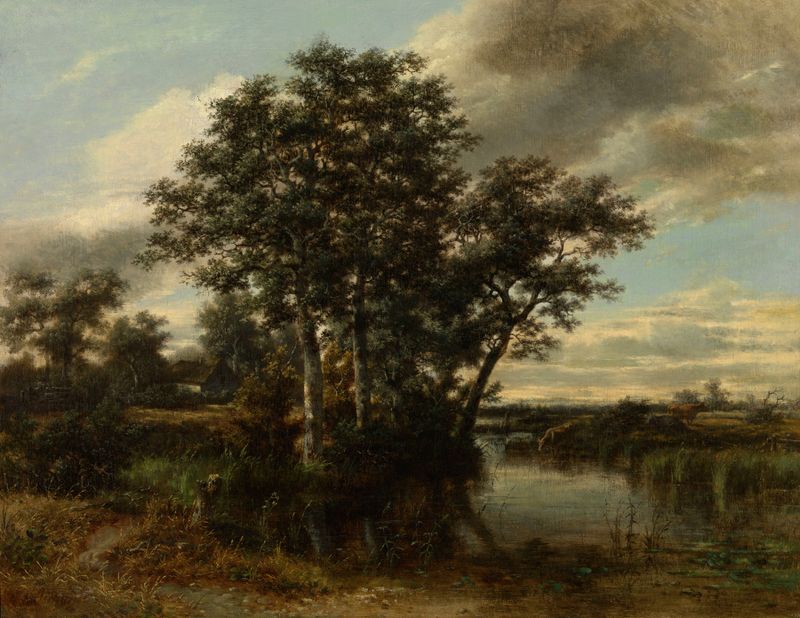
Could beauty survive in a century of chaos? In Farm in Merksem, the delicate interplay of nature and rural life whispers a gentle affirmation that it can indeed flourish amidst turmoil. Look to the left at the sunlit fields, where vibrant greens and soft yellows create a patchwork of fertile earth. The brushwork is both precise and fluid, allowing the viewer to feel the gentle caress of the breeze and the warmth of the midday sun. Notice how the horizon softly blurs—a technique that draws the eye toward the horizon line, inviting contemplation beyond the immediate scene, as if the landscape itself is a gateway to something greater.
The clouds drift lazily, their white forms contrasting starkly with the deep blue above, encapsulating a moment of serene existence. Yet, beneath this picturesque facade lies an emotional tension. The fenced boundaries in the foreground suggest confinement while the horizon beckons with possibilities; a metaphor for human aspiration caught between safety and freedom. The farmhouse, sturdy yet humble, stands as a testament to resilience, embodying both the fragility of rural life and the profound connection to the land.
Each element in the composition, from the gnarled trees to the distant hills, resonates with a quiet dignity, underscoring the theme of transcendence amidst adversity. In 1863, Piéron painted this work during a period marked by political unrest and transformation in Europe. Living in Belgium, he found himself at the intersection of traditional rural life and the profound changes brought about by industrialization. This painting embodies his desire to capture the enduring beauty of the countryside, providing an escape from the chaos of contemporary life while reflecting the resilient spirit of the era.