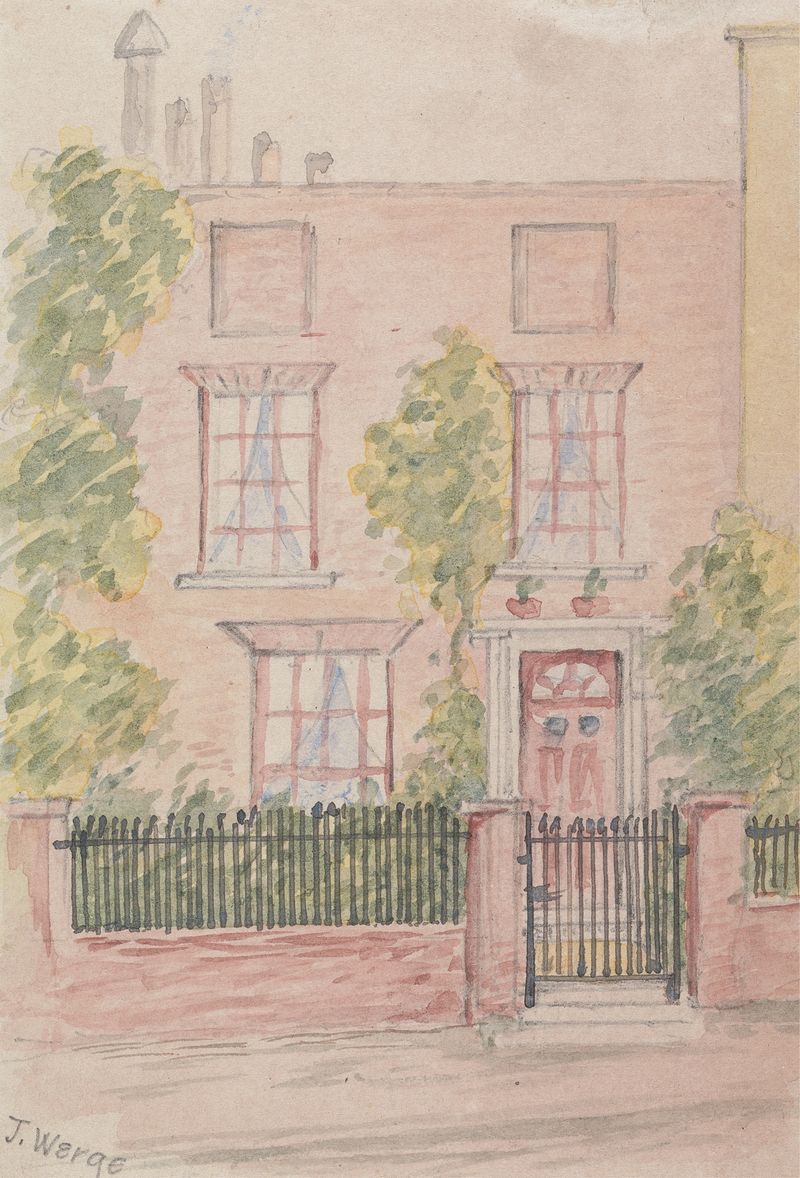
Fifteen, Downshire Hill, Hampstead — History & Facts
This complex interplay of yearning and serenity pulses within the canvas, inviting a deeper exploration of the human condition. First, look to the gentle curvature of the road that beckons towards the horizon, framed by lush greenery. The way the light filters through the leaves creates a golden dappling effect, casting a dreamlike quality over the scene. Notice how the warm hues of the foliage contrast with the cooler tones of the distant buildings, accentuating both the harmony and the distance between nature and civilization.
The delicate brushwork captures a fleeting moment of tranquility, yet it hints at an underlying sense of disquiet. As you draw closer, you might feel the tension between the idyllic setting and a poignant sense of longing. The vibrant flora teases the viewer with its vitality, while the distant structures loom like silent witnesses to human aspirations—the juxtaposition of nature's beauty against human encroachment speaks to the heart's unquenchable desire for connection. Each detail, from the sway of the grass to the shadow play, reveals not just a landscape but an emotional landscape yearning for something just beyond reach. John Werge painted this piece in 1898 while living in London, amidst a period of artistic evolution marked by the rise of the Impressionists.
Seeking to capture the essence of fleeting moments, he found himself drawn to the suburb of Hampstead, a location rich with both natural beauty and the burgeoning modernity of the city. This work reflects his unique ability to weave emotion into the fabric of a landscape, illustrating a moment that resonates with both personal and universal longing.