Grand Canyon Yellowstone — History & Facts
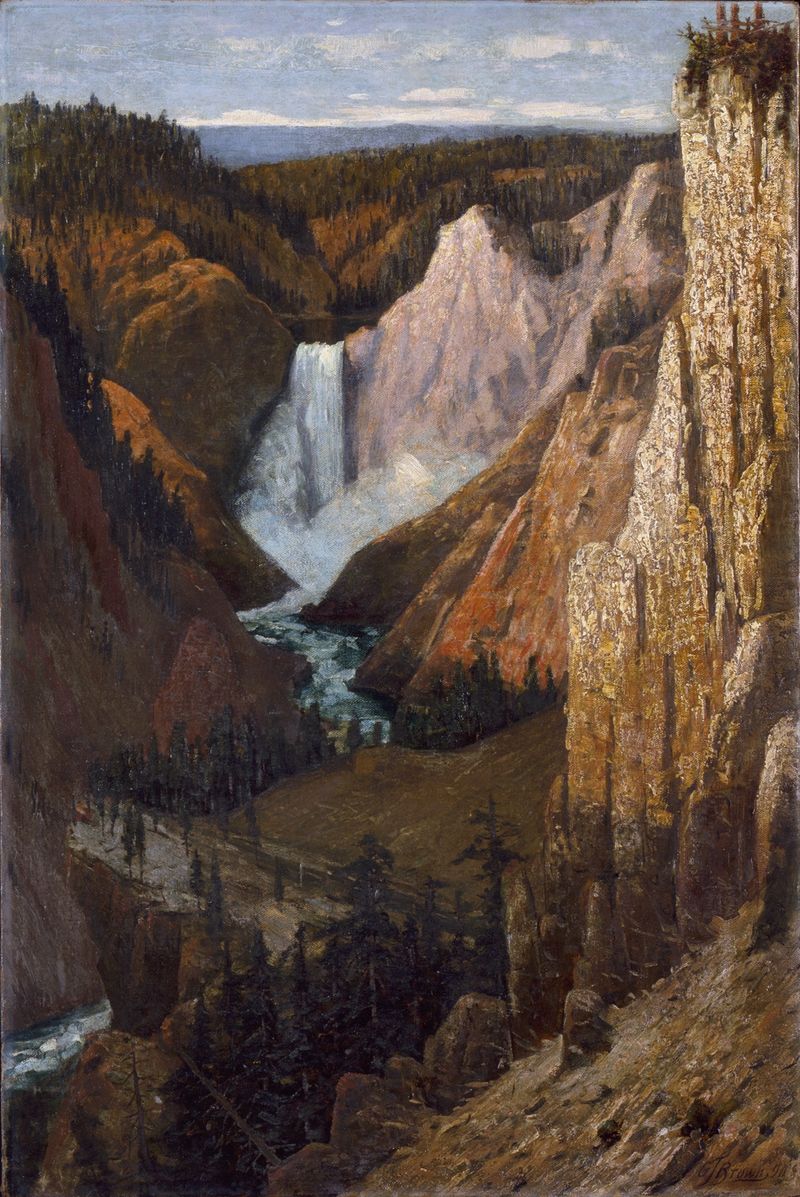
Where does light end, and longing begin? In the crevices of a canyon, beauty emerges as both a refuge and a yearning, whispering the secrets of nature's grandeur. Focus on the majesty of the canyon's layered rock formations. Look closely at the interplay of warm ochres and deep, shadowy blues; they create a dialogue between light and texture. The sky, brushed with delicate clouds, looms above in a soft gradient, while a river snakes through the valley below, its silver sheen drawing the eye.
Each stroke masterfully captures the essence of fleeting moments, inviting you to step into the vastness that seems to stretch infinitely. The painting expresses an emotional dichotomy—between the solidity of the earth and the ethereal quality of the sky. Notice how the rough terrain contrasts with the gentle illumination from above, symbolizing the duality of human experience—our rootedness in reality juxtaposed with our dreams that soar beyond. There exists a palpable tension, an invitation to traverse the emotional landscape that is as profound as the physical. In 1889, Grafton Tyler Brown painted this piece during a pivotal time in his career, as he forged a path in a predominantly white art world.
Residing in California, he was inspired by the natural beauty of the American West and the burgeoning national park movement. His work contributed to the visual storytelling of America’s landscapes, highlighting both their magnificence and the complex narratives of identity and belonging that surrounded them.