Heuernte im Voralpenland — History & Facts
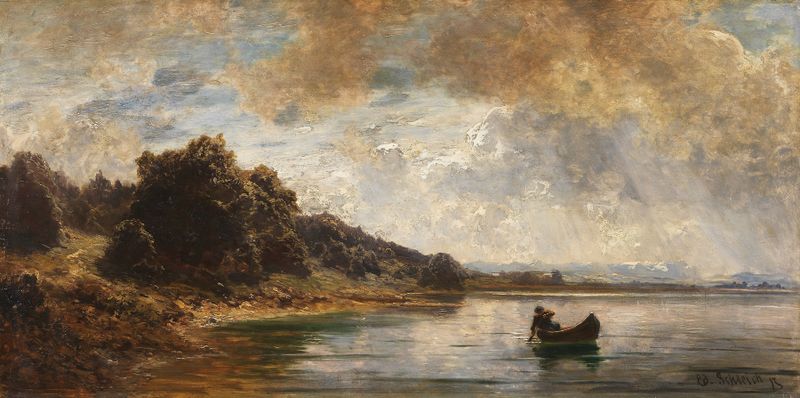
What if silence could speak through light? In Eduard Schleich The Younger's Heuernte im Voralpenland, the soft, golden hues whisper of a world caught in a transient moment, as nature prepares to let go of what was once vibrant. Focus on the gentle slope of the hills that cradle the hay harvest, where the sunlight gracefully spills across the fields, illuminating the workers bent in their tasks. Look closely at the intricate play of light and shadow, where the sun kisses the hay, creating a warm amber glow that contrasts with the cool greens and browns of the landscape. The composition guides the eye along the curve of the field, creating a rhythmic flow that invites viewers into this peaceful scene, evoking a sense of harmony and industriousness. Yet beneath this serene surface lies a poignant tension—an implicit acknowledgment of decay.
The gathered hay signifies both abundance and the imminent cycle of nature's decline; the vibrancy of life teeters on the edge of withering away. The sparse figures, small against the vastness of the landscape, remind us of humanity's fleeting presence in a world that relentlessly turns. In this stillness, one can sense the impending change, a reminder that even the most idyllic moments are temporary. Painted between 1860 and 1880, during a period marked by a burgeoning interest in realism, the artist found inspiration in the idyllic landscapes of Bavaria.
This was a time when the pastoral scenes celebrated the simplicity of rural life amidst the encroaching industrial age, reflecting both a nostalgia for the past and a recognition of life's transitory nature. Schleich's work emerged from an era grappling with change, capturing the essence of a world that was on the brink of transformation.