
Ideale Berglandschaft mit Brücke — History & Facts
When did color learn to lie? The palette before us breathes an unsettling tranquility, inviting us to question the veracity of nature’s hues. Look to the center, where a delicate bridge spans a gentle stream, an elegant curve of wood that invites the eye and suggests a journey. Notice how the verdant greens of the hillside contrast with the deep blues of the water, both enhanced by Schinnagl’s deft brushwork. The interplay of light and shadow dances across the landscape, lending a surreal quality that blurs the boundaries between reality and imagination, suggesting that the artist has crafted an idealized version of nature. Beneath the serene surface, tensions arise from the juxtaposition of the lush landscape and the precarious bridge.
The bridge symbolizes connection, yet it appears almost ephemeral against the permanence of the surrounding mountains. Each stroke of color raises questions about stability and balance, suggesting that what appears idyllic may harbor an underlying fragility. The tranquil scene belies a deeper meditation on the nature of harmony, inviting viewers to contemplate their own journeys through life’s uncertainties. Created during an era of burgeoning romanticism, the artist crafted this piece in a time when nature was increasingly romanticized in art.
Schinnagl, working in the 19th century, was influenced by contemporaneous shifts towards idealized landscapes, reflecting both personal introspection and societal change. His yearning for balance amid chaos reflects the artist's own experiences and the cultural currents of his time, where nature served both as solace and a mirror to the human condition.
More Artworks by Maximilian Joseph Schinnagl
Browse all →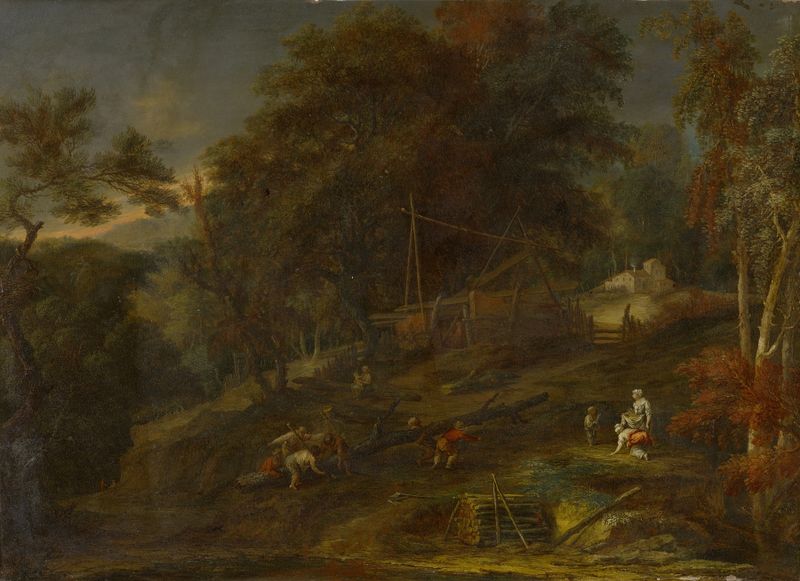
Forest Landscape with Staffage Figures
Maximilian Joseph Schinnagl

Waldlandschaft ‘Abend’
Maximilian Joseph Schinnagl

Ideale Berglandschaft mit Gehöft
Maximilian Joseph Schinnagl

Waldlandschaft mit Gewässer links
Maximilian Joseph Schinnagl

Waldlandschaft ‘Morgen’
Maximilian Joseph Schinnagl

Waldlandschaft mit Gewässer rechts
Maximilian Joseph Schinnagl





