Ideallandschaft mit Tempelanlage — History & Facts
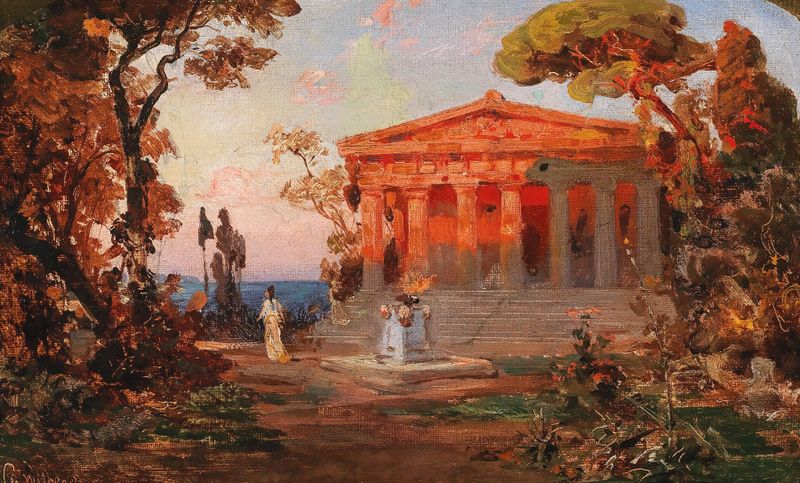
Can beauty exist without sorrow? In the delicate interplay of light and shadow, an eternal question emerges, inviting the viewer to wander through the depths of emotion encapsulated within the canvas. Look to the foreground, where gentle hills roll like whispers beneath a soft, muted sky. The temple structure, poised on the horizon, commands attention with its classical grace, while shadows stretch long and ethereal, contrasting against the vibrant greens and blues that dominate the landscape. Notice how the light dances upon the temple's columns, illuminating the architectural detail, yet leaving the surrounding wilderness in a soft, meditative gloom.
This balance between illumination and obscurity establishes a serene yet evocative tension. As you delve deeper into the scene, the shadows hint at hidden stories—perhaps of worshippers long past, their presence felt but not seen. The temple, a symbol of human aspiration, stands resilient against the encroaching wilderness, representing an ideal that can never be fully realized. The lush landscape, teeming with life, contrasts with the stillness of the architectural wonders, suggesting that even in beauty, there rests a quiet melancholy—a reminder of the transient nature of both art and existence. Christian Wilberg painted this work during a period of artistic exploration, likely in the late 18th or early 19th century—an era marked by a growing interest in Romanticism and the sublime.
While specific details of his life remain elusive, this piece reflects the broader movement seeking to reconcile human emotion with the vastness of nature, capturing the essence of an idealized world that remains forever just out of reach.