Imaginary View of a Riverside Town with Aachen Cathedral — History & Facts
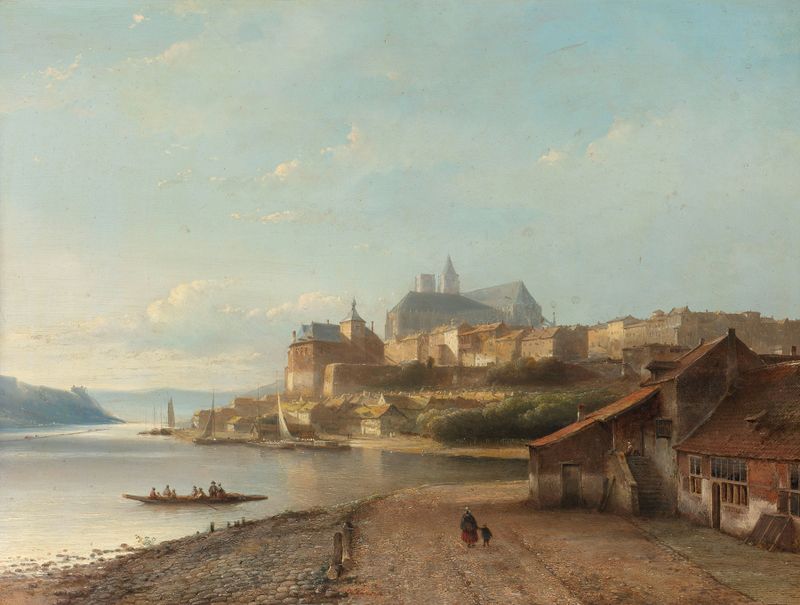
What if beauty was never meant to be finished? In the stillness of Imaginary View of a Riverside Town with Aachen Cathedral, Kasparus Karsen captures a moment that teeters on the edge of tranquility and chaos, inviting contemplation of perfection that remains elusive. Look to the left, where soft ripples dance on the water's surface, reflecting the delicate hues of the early morning sky. The cathedral rises majestically, its spires reaching for the heavens, while a network of quaint houses lines the riverside, their warm tones contrasting against the cool blues and greens of nature. Notice how Karsen uses fine brushstrokes to create a harmony of texture — the smoothness of the water juxtaposed with the ruggedness of the landscape, hinting at the delicate balance between the serene and the tumultuous, that lies beneath the surface. At first glance, the scene breathes serenity, yet tension lurks within the composition.
The carefully rendered architecture stands in juxtaposition to the wild, untamed elements of nature, suggesting a struggle between human ambition and the chaos of the natural world. Furthermore, the subtle interplay of light and shadow reflects the transient moments of beauty, reminding us that even in idyllic settings, there is a fragile impermanence that permeates life. In 1846, Karsen crafted this piece amidst a flourishing art scene in the Netherlands, where Romanticism was giving way to realism. He was deeply influenced by the serene landscapes of his surroundings, yet the undercurrents of industrial expansion loomed large.
This painting not only showcases his technical skill but also his profound commentary on the paradox of human creation set against the ever-changing natural world.