Italienische Landschaft mit Bauern und Vieh am Brunnen — History & Facts
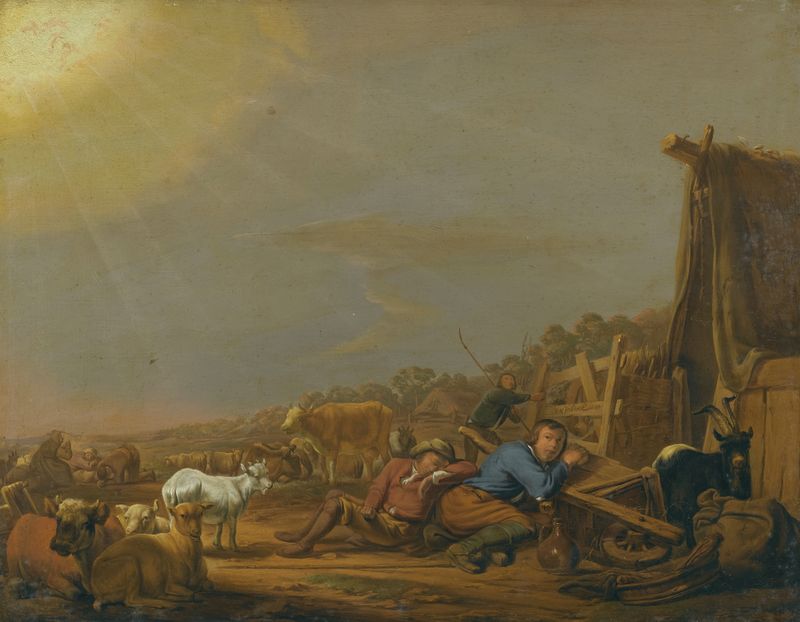
What if beauty was never meant to be finished? Instead, it lingers in the delicate balance of nature and human existence, perpetually in flux. Begin by focusing on the lush landscape that stretches across the canvas, where vibrant greens and soft browns intermingle under a warm, golden light. The farmers and livestock huddle near the well, their forms harmonizing with the surroundings, drawing the viewer's eye to the gentle curve of the well's structure. Notice how the play of light dances upon the water's surface, creating a momentary reflection that captures both the sky and the figures, hinting at deeper connections and shared sustenance. Beyond the surface beauty lies a poignant commentary on fragility.
The farmers' toil suggests a fleeting moment in time, where the simplicity of rural life reveals the underlying tensions of survival and harmony with nature. The presence of the well signifies a critical resource, representing both sustenance and dependency, inviting questions about the precariousness of this idyllic existence. The juxtaposition of the serene landscape with the labor of the farmers invokes a bittersweet awareness of the cycles of life and the inevitable passage of time. Jan van Ossenbeeck painted this work during an era steeped in the transition from the Baroque to the Enlightenment, likely in the late 17th century.
Living in a time of artistic exploration, he sought to blend realism with the pastoral ideal, reflecting the socio-economic changes of rural life. This work encapsulates his engagement with the themes of labor, nature, and the beauty that exists in the everyday, revealing the interplay between human effort and the landscape that sustains it.