
Justuskirche in Flums — History & Facts
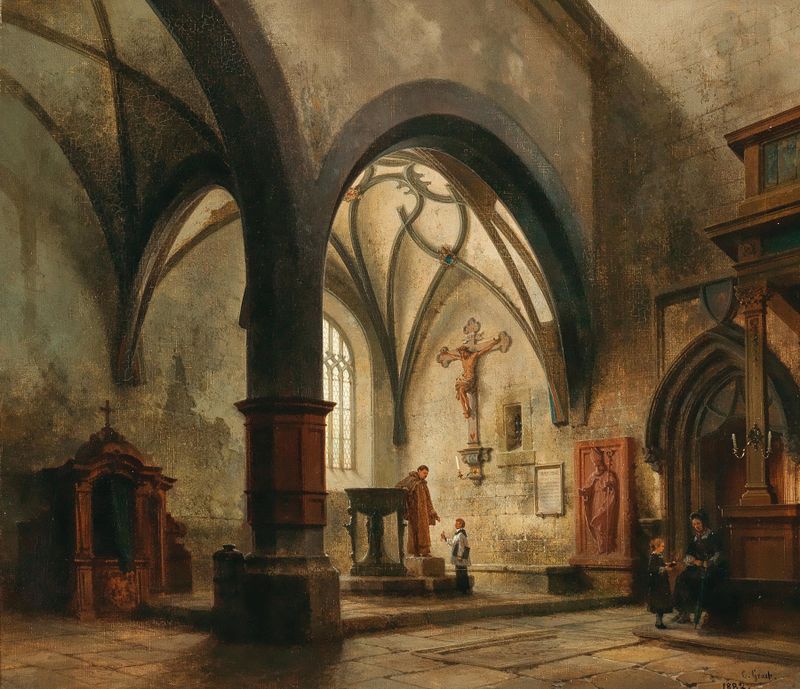
Where does light end, and longing begin? In the realm of dreams, the boundaries blur, rendering the ethereal tangible. Look closely at the intricate architecture of the Justuskirche, the way the light dances upon the stone facades, casting delicate shadows that breathe life into the scene. Notice how the artist expertly captures the texture of the weathered walls, each stroke a whisper of history. Focus on the luminous sky above, a soft gradient of blues and whites that envelops the church, creating a sense of serenity that draws one in, inviting contemplation. The serene stillness of the composition contrasts with the vibrancy implied by the surrounding nature, hinting at stories untold.
The viewer might sense a yearning within the scene, an echo of lives lived in the sacred space of worship. The juxtaposition of the sturdy structure against the fleeting clouds above speaks to the transience of existence, merging the physical and spiritual realms in perfect harmony. Created in an era where the Romantic movement was blossoming, the artist painted this scene during a time of reflection on nature and spirituality. The 19th century was marked by a profound exploration of emotional depth and individual experience.
As Graeb delved into the relationship between humanity and its sacred spaces, he captured a moment that resonates deeply with viewers, inviting them to explore their own dreams and longings within the sacred light of contemplation.
More Artworks by Carl Georg Anton Graeb
Browse all →
More Architecture Art
Browse all →
The statue of Liberty
Frédéric Auguste Bartholdi

View of Houses in Delft, Known as ‘The Little Street’
Johannes Vermeer

View of Houses in Delft, Known as ‘The Little Street’
Johannes Vermeer

The Cathedral in Rouen. The portal, Grey Weather
Claude Monet

The yellow house
Vincent van Gogh

The Church in Auvers-sur-Oise, View from the Chevet
Vincent van Gogh