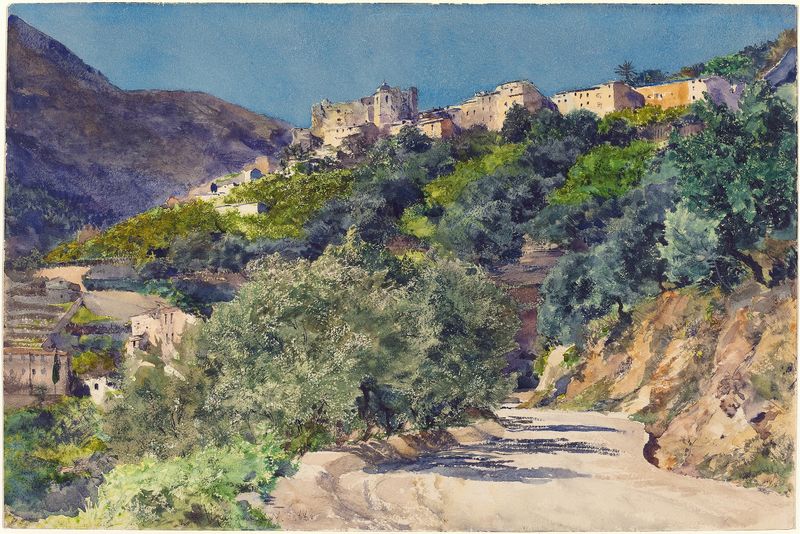
Landhuizen aan de voet van de bergen, hooggebergte in het verschiet, La Turbie — History & Facts
Who listens when art speaks of silence? In the stillness of the landscape, profound absence is inscribed within the gentle contours of the hills and the humble dwellings below. Look to the left at the quaint farmhouses snug against the base of the mountains, their muted colors harmonizing with the soft hues of the sky. Notice how the painter's brush captures the delicate interplay of light across the rooftops, illuminating their surfaces while the rest falls into shadow. The composition invites your gaze upward, leading you towards the soaring peaks in the distance, where the crispness of the high-altitude air is almost palpable. As your eyes wander, you may detect an underlying tension—an interplay between the stark permanence of the mountains and the fragility of human life, represented by the small, fleeting structures below.
This juxtaposition evokes a sense of loss: the timelessness of nature contrasted with the temporal existence of mankind. The soft, hazy outlines of the farthest peaks whisper of dreams unfulfilled and aspirations that fade into the background, as if echoing memories of things left behind. In 1875, the artist found himself in La Turbie, surrounded by the breathtaking architecture of the French landscape. This was a period marked by a burgeoning interest in realism and impressionism, where artists sought to capture the essence of their environment.
Jacquemart's focus on the serene yet poignant connection between humanity and nature reflects the broader artistic movements of his time, as well as his own contemplations of life's transience.