Landscape in the Evening — History & Facts
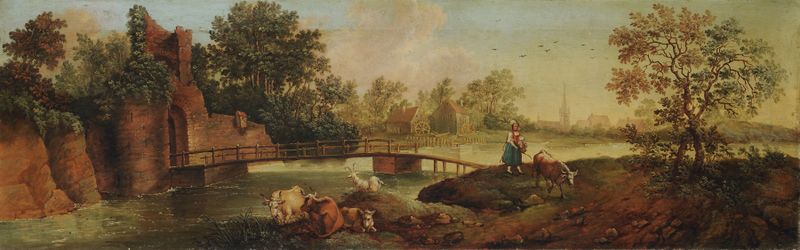
Who listens when art speaks of silence? In Landscape in the Evening, the delicate whispers of twilight remind us of our own fragility in the face of nature’s vastness. This serene representation invites contemplation, urging the viewer to pause and reflect on the transient beauty surrounding us. Look toward the horizon, where soft hues of blue and gold intertwine, creating a sense of depth and tranquility. The gentle brushstrokes evoke a sense of motion, as if the evening sky is unfurling its colors before our eyes.
Notice how the light dances upon the landscape, casting elongated shadows that stretch and bend, emphasizing both the solitude of the scene and the whispers of the wind through the trees. The composition, balanced and harmonious, leads the viewer's eye to the horizon, where the day’s end becomes a metaphor for both closure and possibility. Within this serene landscape lie the emotional tensions of impermanence and renewal. The fading light represents the fleeting moments of life, while the sturdy trees stand as silent witnesses to the passage of time.
The interplay between the darkening sky and the warm earth beneath suggests a fragile equilibrium, capturing the essence of existence—a reminder that beauty is often found in the ephemeral. Each element speaks of a deeper truth, highlighting the necessity of cherishing the moments we often take for granted. Franz Feyerabend painted this evocative scene in 1490, during a period marked by the transition from medieval to Renaissance ideals. Working in the heart of Europe, he experienced a world ripe with exploration and reflection.
As the burgeoning art scene began to embrace humanism and the natural world, Feyerabend sought to capture the essence of that awakening, grounding his work in the beauty and fragility of everyday life.