Landscape with a Train — History & Facts
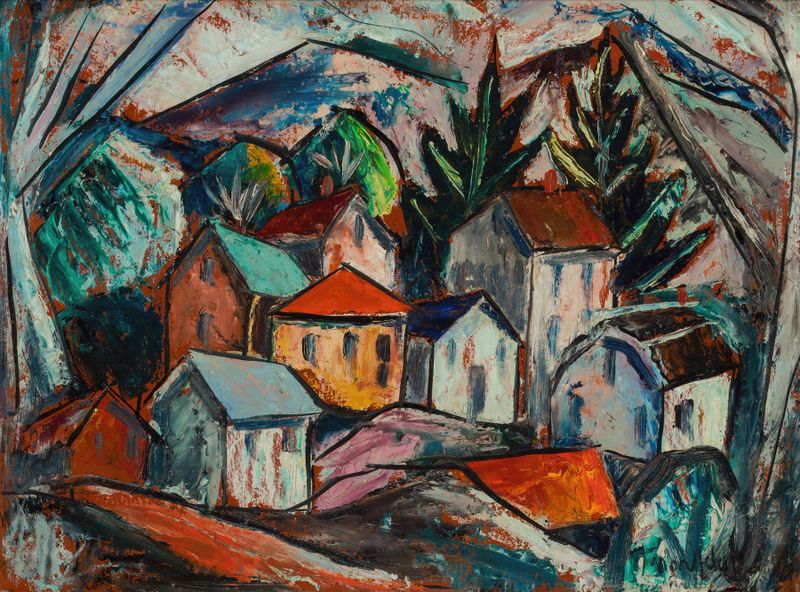
Is this a mirror — or a memory? The stillness of Landscape with a Train invites us to ponder the delicate balance between what we see and what we remember. The scene breathes with an eerie silence, where the train’s presence seems to echo through the landscape, binding past and present. Focus first on the bright, swirling clouds that dominate the upper portion of the canvas, their rich blues and whites contrasting sharply against the earthy tones below. The train, rendered with meticulous detail, cuts through the landscape with its dark, industrial shape, yet it feels almost ethereal against the vibrant backdrop.
Notice how the light plays upon the fields, revealing patches of golden wheat that ripple, caught in a breeze that seems trapped in time. The composition invites the viewer's eye to dance along the horizon, where the train's path intersects with the vastness of nature. As you delve deeper into the artwork, reveal the emotional tensions simmering beneath its surface. The juxtaposition of man-made machinery against the natural landscape speaks to the encroachment of progress upon serenity, hinting at a bygone era where trains were harbingers of change.
Yet, there’s a haunting stillness; the fields are lush but vacant, evoking a sense of nostalgia for a time when nature reigned supreme. Each brushstroke seems to carry a whisper, a reminder of the quiet moments that slip away unnoticed. Created in the late 19th to early 20th century, this piece reflects the artist’s life during a period of significant transition in the art world, where traditional landscapes began to meld with modern elements. Nordfeldt was responding to shifting societal norms and the rise of industrialization, capturing the delicate interplay between technology and the environment.
His work often featured this duality, as he sought to document not just the physical landscape but the emotional landscape of his time.