Landscape with Cattle — History & Facts
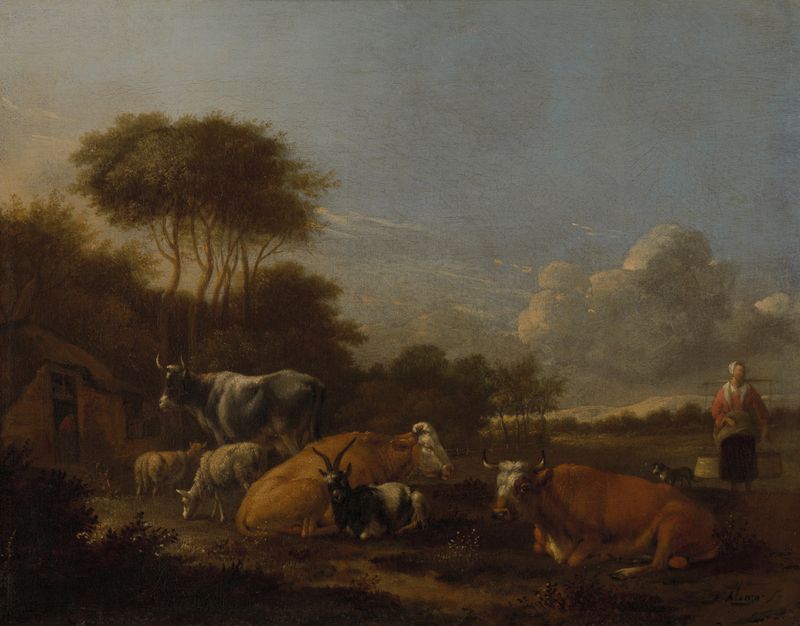
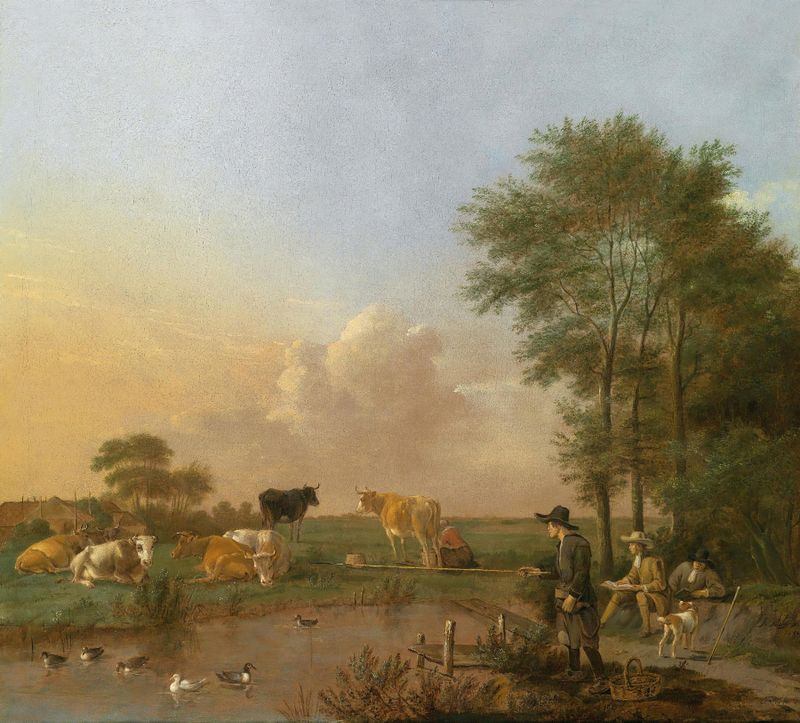
Who listens when art speaks of silence? In the quiet expanses of a fading world, decay lingers, waiting for recognition. Look to the left at the gently grazing cattle, their forms softened by the muted earth tones that define the landscape. Notice how the wisps of sky blend delicately with the horizon, the clouds hanging low and heavy, almost as if muffling the sounds of the scene. The brushwork displays a subtle interplay of light and shadow, guiding your gaze through the composition while the hues of ochre and green evoke a sense of tranquility, suggesting both life and the inevitable passage of time. As you observe, feel the emotional tension of the scene.
The cattle, though part of a pastoral setting, reflect an underlying melancholy, as if their presence signifies a simpler time slipping away. The landscape itself appears to breathe in this stillness, yet hints at a slower decay, revealing the fragility of existence. The balance of nature and the inevitability of decline create a poignant dialogue about continuity and loss. Painted during the latter half of the 17th century, this work emerged from the Dutch Golden Age, a time when many artists explored the interplay of light, nature, and human connection.
Klomp's focus on tranquil rural scenes captures the essence of a society in transition, where the idyllic life was beginning to give way to modernity. His choice to depict such a moment reflects the prevailing tension of that era, inviting viewers to contemplate both beauty and decay.