Landscape with people and cattle — History & Facts
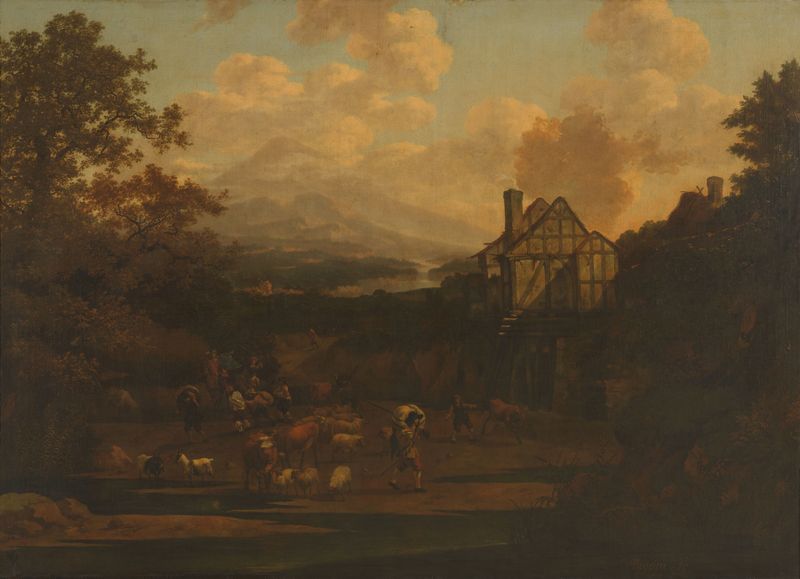
Did the painter know this moment would outlive them? In Landscape with people and cattle, there lies an echo of innocence, a stillness that whispers across centuries, inviting us to ponder the passage of time and the purity of rural life. Focus on the cattle grazing peacefully in the foreground, their soft forms contrasting with the vibrant greens of the landscape. The figures of men and women, clad in simple attire, harmoniously blend into the natural setting. Notice how the light filters through the trees, casting gentle shadows that extend toward the horizon, creating a serene ambiance.
The palette of subtle earth tones with splashes of brighter hues complements the tranquility, making the scene both idyllic and timeless. Yet, beneath this pastoral stillness, one may sense a deeper narrative. The arrangement of the figures hints at an unspoken connection between humanity and nature, juxtaposing the innocence of these everyday moments against the relentless march of time. The gentle sway of the cattle, the distant hills, and the expansive sky all evoke a profound sense of peace, but also a fleeting quality, as if the scene captures a single breath in the vastness of existence.
Here lies an invitation to reflect on our own relationship with nature and the fragility of such beautiful simplicity. Abraham Jansz. Begeyn painted this work in the 17th century, a time marked by the flourishing of Dutch landscape painting. Living in a period characterized by a burgeoning appreciation for the natural world, Begeyn was part of a movement that sought to elevate everyday scenes to the status of fine art.
His focus on pastoral life not only reflects his surroundings but also intertwines with the broader cultural values of his time, where the simplicity and beauty of rural existence were celebrated amidst the complexities of urban life.