Landschaft — History & Facts
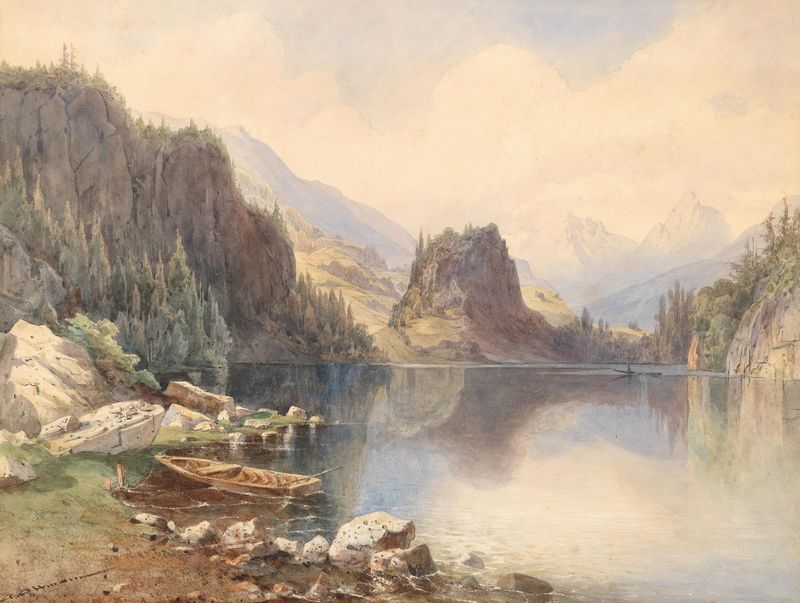
Could a single brushstroke hold eternity? In Anton Altmann's Landschaft, the answer lies in the unseen chaos beneath the tranquil surface. The painting invites us to question the very nature of reality and our connection to it. Look to the left at the rolling hills, where deep greens blend seamlessly into soft yellows kissed by sunlight. The horizon stretches across the canvas, inviting the eye to wander into the distance.
Notice how the light falls upon the water, reflecting the sky’s gentle hues, while shadows cloak the valleys, creating a symphony of contrasts. Each brushstroke feels deliberate, as if Altmann sought to capture not just the landscape, but the emotional undercurrents that pulse through it. Yet within this serene setting lies a tension that suggests madness simmering just beneath. The interplay of light and shadow speaks to the duality of nature—beauty intertwined with turmoil.
The sweeping clouds seem to whisper secrets, hinting at storms to come, while the calmness of the water masks deeper currents. The viewer can sense that what appears idyllic is, in fact, a fragile moment poised precariously between tranquility and chaos. In 1850, Altmann painted this piece during a time of great transition in the art world. As the Romantic movement gave way to more modern sensibilities, he found himself navigating the space between classical techniques and the burgeoning explorations of impressionism.
This tension reflects not only his personal artistic journey but also the broader cultural shifts that were reshaping how people perceived nature and emotion.