Landschaft, Felsgestein — History & Facts
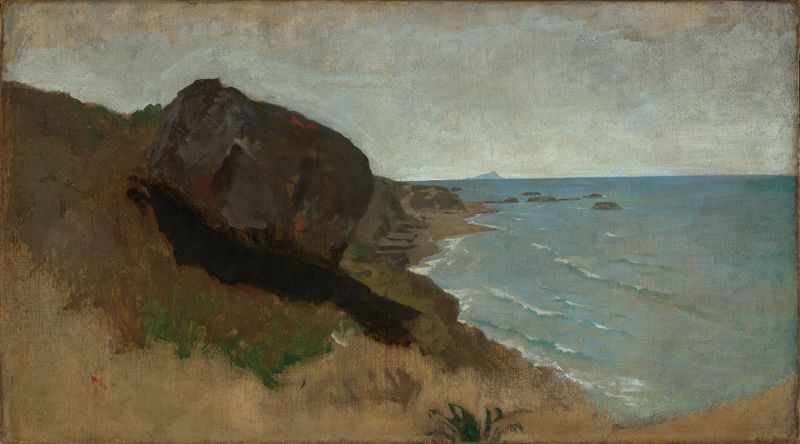
Did the painter know this moment would outlive them? In Landschaft, Felsgestein, the essence of transformation breathes amidst the rugged terrain, where nature's grandeur and fragility coexist. Look to the foreground where jagged rocks emerge like ancient sentinels, their edges softened by a delicate play of light. The artist employs a palette of muted greens and earthy browns, inviting your gaze through the contrasting shadows that dance across the surface. The subtle gradations of color create depth, leading your eye toward the distant horizon, where mist cloaks the mountains in a shroud of mystery.
The composition evokes a sense of both permanence and transience, a balance between the steadfastness of stone and the ephemeral nature of the sky. Here, the emotional tension resides in the interplay between the solid and the elusive. The starkness of the rock formations symbolizes resilience, yet the wispy clouds above suggest an ever-changing world, reminding us of the inevitability of change. Each detail, from the texture of the stone to the fluidity of the sky, encapsulates the transient beauty of landscapes that have witnessed the passage of time.
The work becomes a meditation on both the stability of nature and the fragility of human existence. Anselm Feuerbach painted this work during a formative period in his career, between 1857 and 1858, in his studio in Italy. Influenced by the Romantic movement, he sought to capture the sublime beauty of nature while grappling with personal and societal shifts of the time. As the art world evolved, so did Feuerbach’s vision, reflecting a desire to harmonize the emotional resonance of landscapes with the transformative power of the natural world.