Landschaft mit Hammerwerk — History & Facts
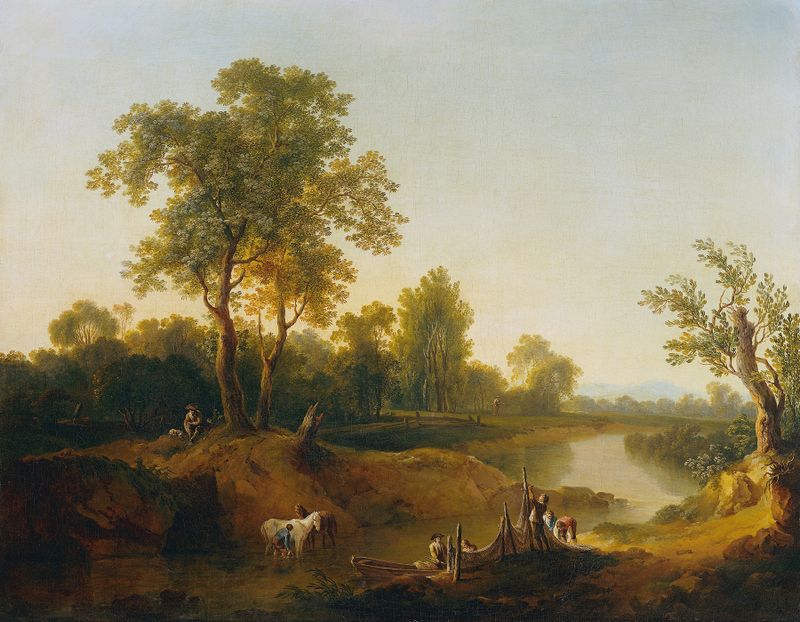
What secret hides in the quiet of the canvas? In Landschaft mit Hammerwerk, serene landscapes invite contemplation, merging nature with human industry in an intimate dance of existence. Focus on the gentle hills that cradle the scene, their muted greens and browns harmonizing under a soft, diffused light. To the right, the hammer mill emerges, its structure both functional and elegant, drawing the eye with a warm earthiness that contrasts with the cooler tones of the surrounding landscape. Notice how the artist’s brushstrokes convey a delicate interplay between the organic forms of the fertile land and the industrious elements of human creation, revealing a thoughtful balance between serenity and labor. The juxtaposition of the tranquil backdrop against the industrious hammer mill speaks volumes about the relationship between humanity and nature.
Shadows stretch long and soft across the ground, hinting at the passage of time, while the distant mountains loom, embodying permanence amidst the transient activities of life. This painting invites reflection on the harmony that can exist between the deliberate actions of mankind and the peacefulness of the natural world. Martin von Molitor created this piece in 1800, a period marked by the transition into the Industrial Revolution, which redefined landscapes and lifestyles. Working in Germany, he sought to capture both the beauty and the burgeoning complexity of his time, reflecting an era grappling with the duality of progress and preservation.
In this work, he masterfully encapsulates a moment of serenity amidst a world on the brink of transformation.