Landschap bij Nevers — History & Facts
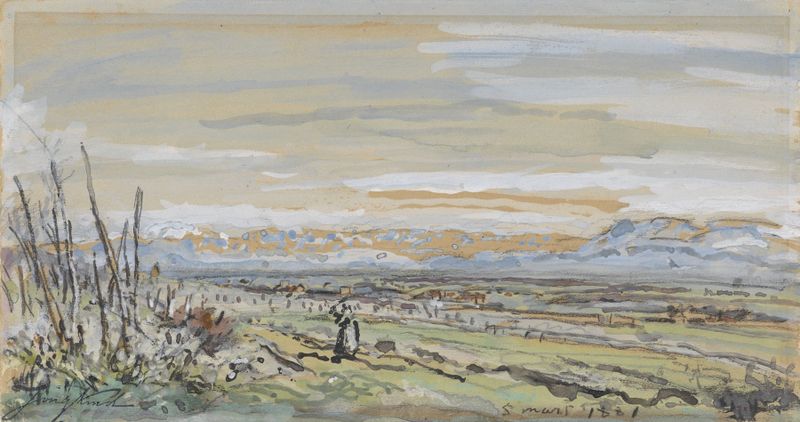
Could beauty survive in a century of chaos? In Landschap bij Nevers, serenity unfolds amidst a backdrop of tumult, inviting us to pause and reflect. Look to the foreground, where a calm river gently snakes through the verdant landscape, drawing the eye to the harmonious interplay of water and land. Notice how the artist employs soft brushstrokes to capture the delicate ripples on the river’s surface, while dappled sunlight filters through lush trees, creating a dance of light and shadow. The horizon, dotted with softly rolling hills, suggests tranquility, yet its muted colors hint at an underlying tension, as if nature holds its breath. In the background, the distant mountains loom quietly, their majestic presence contrasting with the peaceful foreground.
The warm hues of gold and green evoke a sense of nostalgia, evoking the passage of time and the persistent beauty of nature despite human strife. The composition leads the viewer from the serene river to the towering mountains, mirroring the journey from calmness to the chaos that often lies beyond our immediate sight. Painted in 1871, Johan Antonie de Jonge created this work during a period marked by social and political upheaval in Europe, following the Franco-Prussian War. As the art world grappled with realism and impressionism, De Jonge sought to encapsulate the sublime beauty of the natural world, offering a refuge from contemporary turmoil.
His landscapes resonate with a sense of peace, urging viewers to find solace within the chaos of their own times.