Landschap met een hengelaar en een kasteel — History & Facts
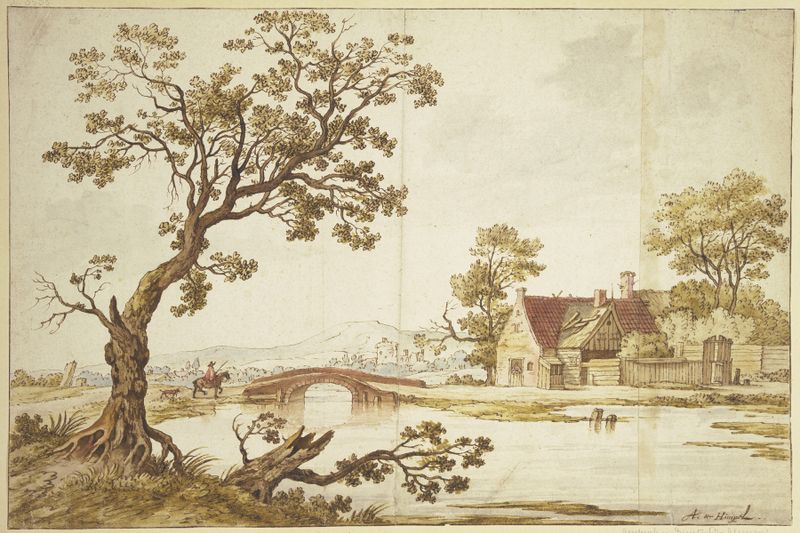
Could beauty survive in a century of chaos? Aernout Ter Himpel's Landschap met een hengelaar en een kasteel transports us to a serene landscape, where the tension between nature and man echoes through the ages. This painting holds a delicate balance between tranquility and decay, inviting the viewer to reflect on the passage of time and its relentless grip on beauty. Look to the left at the fisherman, his solitary figure immersed in the act of casting a line into the still waters. The surrounding landscape bursts with lush greens and vivid blues, contrasting sharply with the crumbling castle perched above.
Notice how the light falls upon the fisherman’s figure, illuminating his labor while casting elongated shadows that hint at the looming decay of the castle. The composition draws the eye gently from the lively foreground to the somber, eroding stone, illustrating the inevitability of ruin. In the interplay of elements, there emerges a profound tension: the vibrant life of the fisherman juxtaposed with the ghostly remnants of the castle. The water reflects not only the sky but also the fragility of existence, suggesting that even amidst beauty, decay is a constant companion.
The lush landscape embodies vitality, while the castle, a monument to human achievement, serves as a reminder of impermanence. Each brushstroke reveals how nature perpetually reclaims its dominion, hinting at a cyclical narrative of creation and destruction. Aernout Ter Himpel created this piece during a period marked by artistic exploration and the emergence of Dutch landscape painting. Active from 1644 to 1686, he navigated a world caught between baroque influences and the growing appreciation for realism in art.
The contrasting themes of beauty and decay reflect the tumultuous socio-political landscape of 17th-century Europe, inviting viewers to ponder the resilience of art even amidst chaos.