Late fall in the beech forest — History & Facts
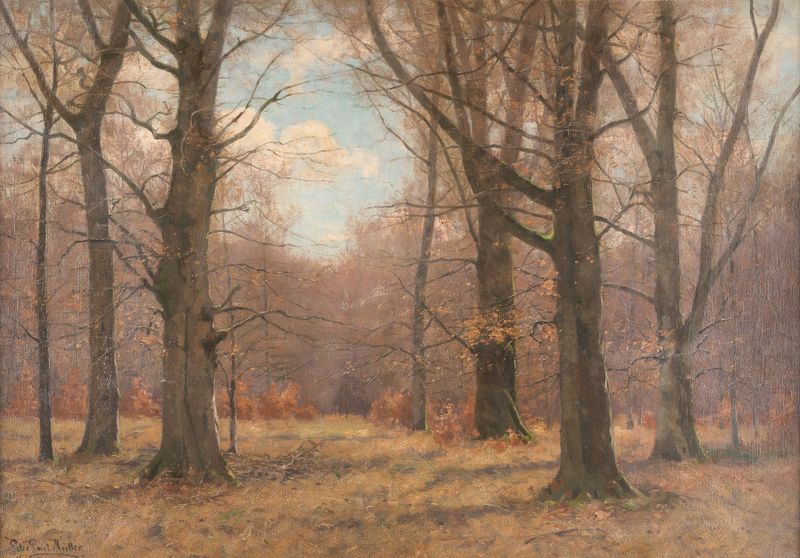
Can beauty exist without sorrow? In Late Fall in the Beech Forest, the answer whispers through the foliage, where each leaf—vibrant yet fading—holds the weight of its impending fate. Notice how your gaze first gravitates toward the golden hues that punctuate the serene greys and browns of the landscape. The artist employs a delicate interplay of light and shadow, with sunbeams filtering through the sparse branches, illuminating the ground in patches. The intricate details of each tree trunk reveal the texture of bark, inviting the viewer to feel the forest’s embrace while hinting at the fleeting nature of life.
This composition, with its gentle slopes and winding paths, leads us deeper into a sanctuary that speaks volumes in silence. Yet, amid the beauty, a tension simmers. The season is late, and the beech trees stand as sentinels of change, their leaves—once full of life—now hinting at the melancholy of loss. The soft carpet of fallen leaves underfoot serves as a reminder of all that has come before, echoing the transient nature of beauty and existence.
There's a profound contrast here: the vibrancy of the remaining leaves juxtaposed with the inevitability of winter's approach, capturing a moment where joy and sorrow coexist as two sides of the same destiny. Created during an uncertain time in the 19th century, Late Fall in the Beech Forest reflects the artist’s introspection amidst the evolving artistic landscape. While the exact date remains unknown, Müller found himself in an age where Romantic ideals began to intertwine with emerging modernism, allowing him to explore themes of nature and emotion. As he painted this scene, he infused it with the complexity of human experience, marking an intersection of personal reflection and broader artistic movements of his time.