
Le Palais de l’industrie — History & Facts
In a moment where noise drowns the whispers of the heart, longing emerges as the silent thread that binds us to our yearning. Focus on the central structure, the imposing silhouette of the Palais de l’industrie that looms against a backdrop of an overcast sky. The intricate details of its façade, with delicate architectural flourishes, draw the gaze and invite contemplation. Notice how the muted grays and soft blues blend seamlessly, evoking a sense of nostalgia and anticipation, while the subtle play of light hints at the promise of something more beyond the confines of the canvas. Around the edges, silhouettes of figures evoke a sense of movement, yet they appear almost ghostly, reinforcing the emotional tension of unfulfilled dreams.
Each figure’s stance seems laden with introspection, as if they are caught between the desires of the moment and the weight of their realities. The contrast between the grandeur of the structure and the smallness of the figures suggests a poignant dialogue between ambition and isolation, revealing layers of longing for connection in a world that often feels indifferent. Eugène Trigoulet painted this work in 1899, a time when the industrial age was reshaping cities and lives. Living in Paris, he found himself at the crossroads of tradition and modernity, mirroring the changing tides in the art world as Impressionism took hold.
This painting reflects not just a building, but a moment in history — a yearning for permanence in an era marked by transience.
More Artworks by Eugène Trigoulet
Browse all →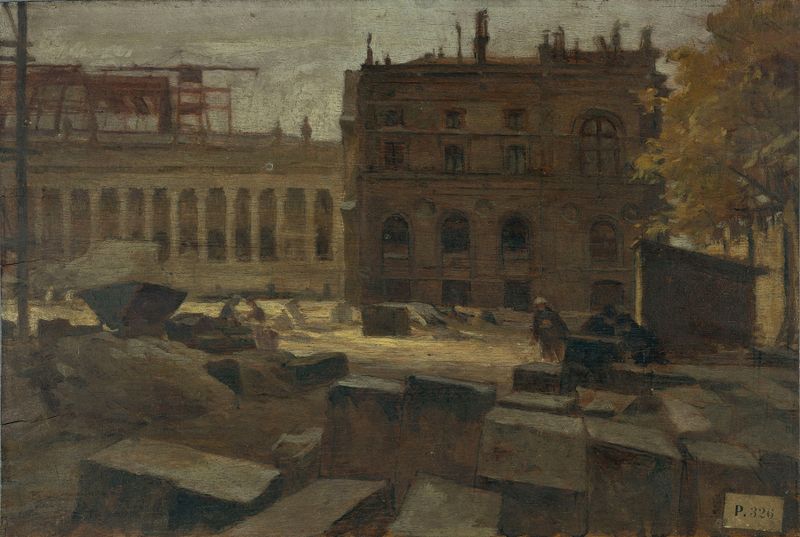
More Architecture Art
Browse all →
The statue of Liberty
Frédéric Auguste Bartholdi

View of Houses in Delft, Known as ‘The Little Street’
Johannes Vermeer

View of Houses in Delft, Known as ‘The Little Street’
Johannes Vermeer

The Cathedral in Rouen. The portal, Grey Weather
Claude Monet

The yellow house
Vincent van Gogh

The Church in Auvers-sur-Oise, View from the Chevet
Vincent van Gogh