
María Teresa (1638–1683), Infanta of Spain — History & Facts
A young girl with pale skin and flushed cheeks faces forward, her head slightly turned to her right. She wears her hair in thick, chestnut curls that are arranged in wide, structured waves extending outward from her head. Large, silvery bows are set into the hair on both sides, catching the light and providing a striking contrast to the dark curls.
The upper part of her dress is visible at the bottom edge of the canvas, rendered in pale tones that blend into the luminous skin of her neck and shoulders. The background is a deep, velvety black, which isolates the figure and heightens the sense of presence. Light falls from the left, illuminating the girl's face and the bows in her hair, while subtle shadows model the roundness of her cheeks and chin.
The brushwork is confident and visible, especially in the textured curls and the soft, feathery treatment of the bows. The painting is composed tightly around the head and shoulders, focusing attention on the sitter's expression and elaborate hairstyle. No secondary figures or objects are visible anywhere in the composition; the sitter is alone against the background.
The upper right and left corners of the canvas show the dark backdrop meeting the edges of the sitter’s hair, with no additional details or ornamentation. The light falls most strongly on the left side of the girl’s face and the left bows, leaving the right side of her face and hair in softer shadow. The background is painted in a deep, nearly uniform black, with only slight tonal variation near the edges of the hair.
The lower left and right corners reveal the faint outline of the sitter’s shoulders and the top of her dress, with loose, sketchy brushstrokes. The paint in the hair is applied with lively, broken strokes that suggest the texture and volume of the curls without strict linear definition. Subtle cracks in the paint surface are visible throughout, especially in the lighter areas of the face and neck. The Metropolitan Museum of Art lists this painting as part of The Jules Bache Collection, acquired in 1949.
Sources: Metropolitan Museum of Art, record 49.7.43 · Wikidata Q19911687
More Artworks by Diego Velázquez

Las Meninas
Diego Velázquez

The Triumph of Bacchus
Diego Velázquez

Rokeby Venus
Diego Velázquez

Equestrian Portrait of Prince Balthasar Charles
Diego Velázquez

Bacchus
Diego Velázquez

Don Gaspar de Guzmán (1587–1645), Count-Duke of Olivares
Diego Velázquez
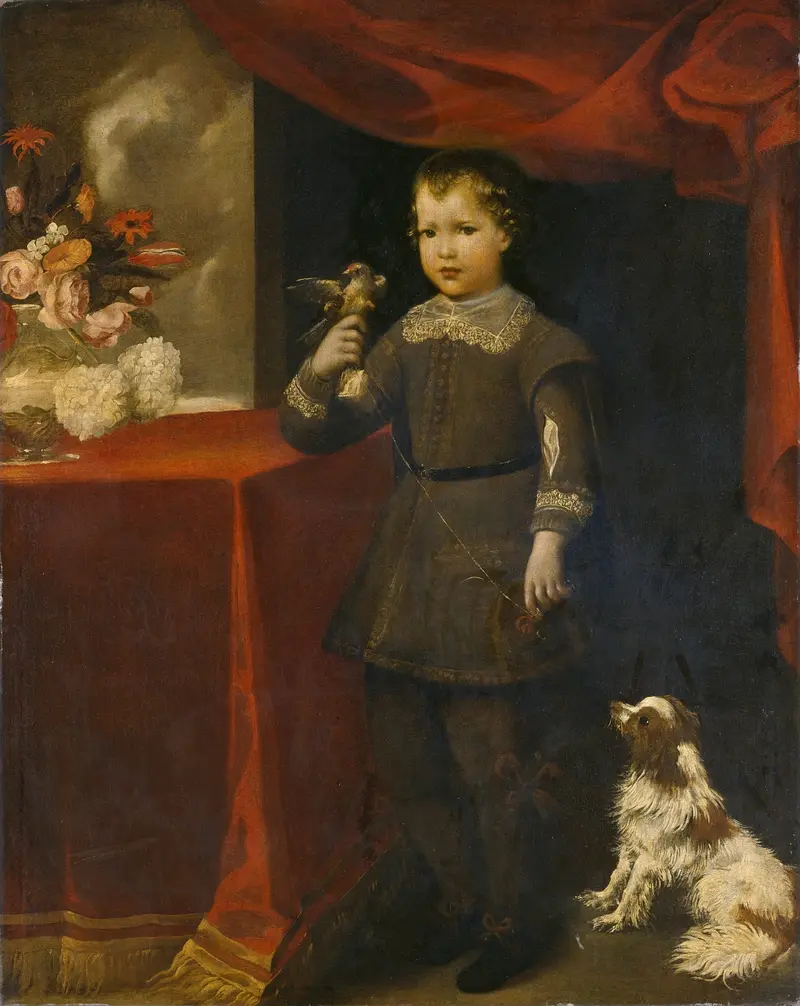
El príncipe Baltasar Carlos de Austria
Diego Velázquez

Equestrian Portrait of Philip III
Diego Velázquez

Equestrian Portrait of Margarita of Austria
Diego Velázquez
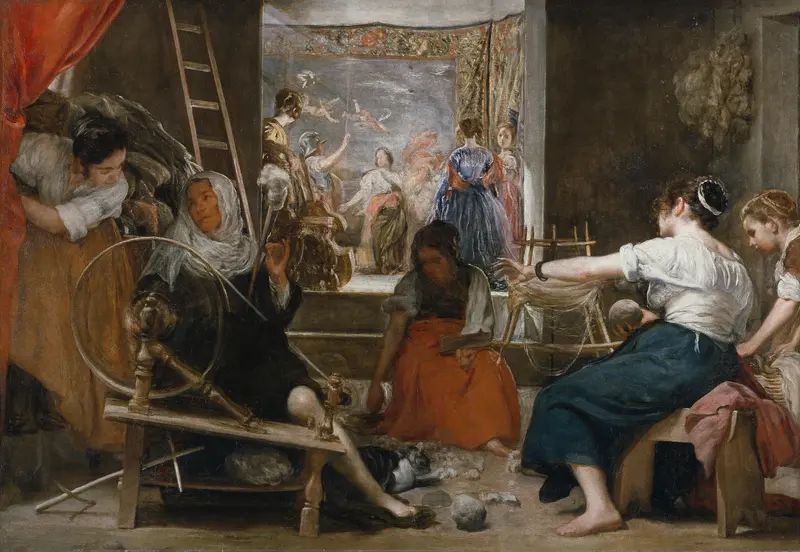
Las Hilanderas
Diego Velázquez




