
Moses and the Daughters of Jethro — History & Facts
When did color learn to lie? A question that reverberates through the ages, whispering secrets of fear and deception hidden within the brushstrokes of the past. This piece evokes a palpable tension, where every hue dances with uncertainty, urging viewers to confront the unknown beneath the surface. Look to the center of the canvas where Moses stands, a towering figure cloaked in rich earth tones that speak of both authority and vulnerability. His expressive gesture reaches out towards the daughters of Jethro, their delicate forms framed by gentle, pastel shades, contrasting sharply with the deep, moody background.
Notice how the light cascades softly onto their solemn faces, illuminating a moment of connection fraught with unspoken anxieties, inviting us to ponder the weight of their circumstances. The emotional tension of the scene lies in the interplay of light and shadow. The daughters seem caught between obedience and defiance, while Moses—a figure of leadership—exudes a quiet desperation. Hidden fears of rejection and the burden of obligation pulse through the interactions, suggesting that this moment is not merely a social exchange but a negotiation of power, identity, and fate.
Here, Sagrestani intricately weaves a narrative of intimacy and distance, urging us to explore what lies beneath the apparent harmony. Created in the late 17th to early 18th century, this work emerged during a time of significant transition in Europe’s artistic landscape. Sagrestani, active in Italy, was part of a movement that sought to bridge Baroque grandeur with nascent classical ideals. As the world faced political upheaval and shifting cultural paradigms, his exploration of emotion and complexity resonates with an audience grappling with their own fears and uncertainties, making this portrayal of biblical themes strikingly relevant.
More Artworks by Giovanni Camillo Sagrestani
Browse all →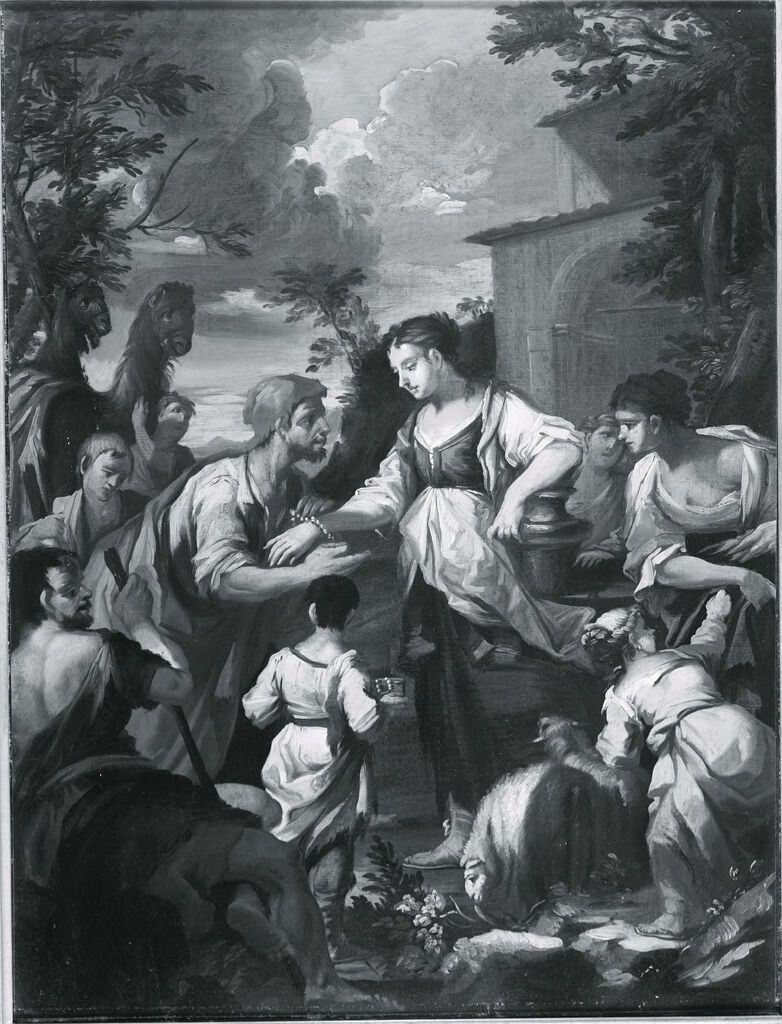
More Religious Art
Browse all →
The Return of the Prodigal Son
Rembrandt van Rijn

The Garden of Earthly Delights
El Bosco

Count Orgaz’ funeral
El Greco

The Hundred Guilder Print: the central piece with Christ preaching, the plate arched
Rembrandt van Rijn

The Descent from the Cross
Rogier van der Weyden

The return of the prodigal son
Rembrandt van Rijn