
Rebecca at the Well with Abraham's Servant — History & Facts
Who listens when art speaks of silence? Within the confines of a painted moment, beauty emerges as a dialogue between figures and the world that envelops them. Focus on the women at the well, their forms gracefully poised beneath the soft illumination of a warm, golden light that bathes the scene. Notice how the rich greens of the surrounding landscape contrast with the delicate attire of Rebecca, suggesting her purity and strength. The careful detail in the folds of her garments draws the eye, inviting a closer examination of her subtle expression—one that hints at both curiosity and resolve. Beyond the immediate spectacle, there lies a narrative of choice and destiny.
The well itself is a symbol of life and nourishment, representing the intersection of fate and agency. The positioning of Abraham's servant—his posture poised yet respectful—underscores the tension of courtship and expectation. Their silent communication becomes a testament to the unspoken bonds that define relationships, while the serene background captivates with its tranquility, contrasting the unfolding drama. Created in the 17th-18th century, during a period rich with baroque influences, the artist found himself at a crossroads of tradition and innovation.
Sagrestani was part of a flourishing artistic movement in Italy that emphasized dramatic expression and intricate narrative scenes. This era witnessed a shift towards greater emotional depth in art, reflecting the complexities of human experience, and Rebecca at the Well with Abraham's Servant captures that very essence, intertwining beauty with the quiet whispers of fate.
More Artworks by Giovanni Camillo Sagrestani
Browse all →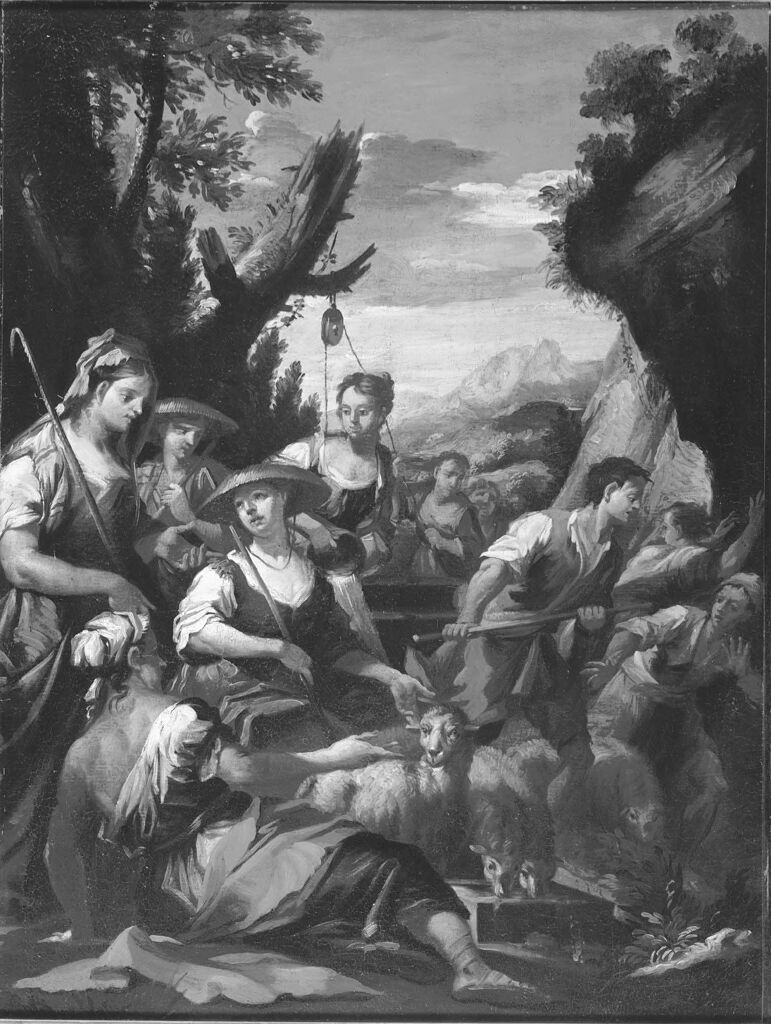
More Historical Art
Browse all →
The Night Watch Militia Company of District II under the Command of Captain Frans Banninck Cocq
Rembrandt van Rijn
Lincoln Memorial
Henry Bacon
The Third of May 1808
Francisco de Goya

Isaac and Rebecca, Known as ‘The Jewish Bride’
Rembrandt van Rijn
The Charge of the Mamelukes (1814)
Francisco de Goya

De vier ruiters van de apocalyps
Albrecht Dürer