
Mosque on the banks of the Nile — History & Facts
In a world shrouded in the fragility of existence, the stillness of sacred places invites introspection and reverence. Look closely at the delicate interplay of light and shadow that dances across the mosque's dome. The artist captures a serene moment where the sun gently illuminates the intricate patterns, creating a luminous halo against the deepening hues of dusk. Notice how the ripples on the Nile reflect fragments of the structure, as if nature itself is whispering secrets to the viewer.
The soft palette of earthy tones blends with hints of vibrant blues, evoking a calm yet contemplative atmosphere. The mosque stands as a symbol of resilience amid the flowing water, emphasizing the transient nature of both life and faith. The juxtaposition of the solid architectural form against the fluidity of the river speaks to the balance between permanence and ephemerality. In the foreground, a solitary figure appears, inviting contemplation on solitude and the weight of belief, while the distant horizon suggests an endless journey yet to unfold. Created in an undefined moment, Veillon’s work reflects an era in which artists were grappling with the interplay of light and emotion.
Set against a backdrop of the late 19th century, a time of exploration and a burgeoning fascination with Orientalism, this painting encapsulated the artist's pursuit of beauty and tranquility amidst an ever-changing world. The mosque, a timeless edifice, stands as a testament to both cultural heritage and the ephemeral human experience.
More Artworks by Auguste Louis Veillon
Browse all →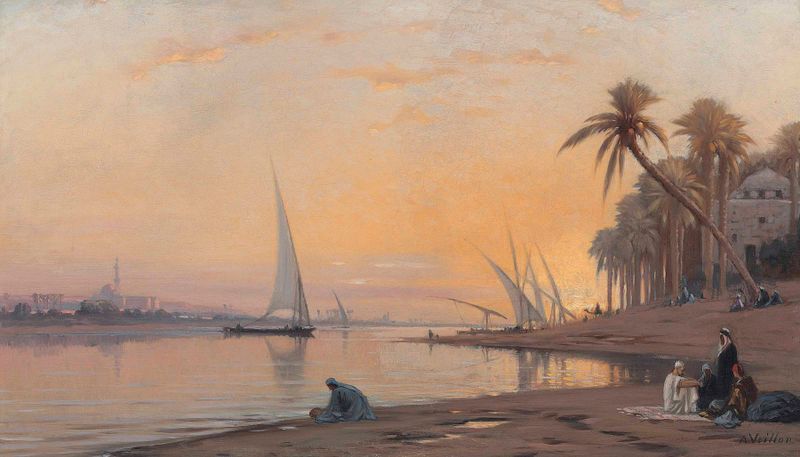
More Architecture Art
Browse all →
The statue of Liberty
Frédéric Auguste Bartholdi

View of Houses in Delft, Known as ‘The Little Street’
Johannes Vermeer

View of Houses in Delft, Known as ‘The Little Street’
Johannes Vermeer

The Cathedral in Rouen. The portal, Grey Weather
Claude Monet

The yellow house
Vincent van Gogh

The Church in Auvers-sur-Oise, View from the Chevet
Vincent van Gogh