Mountain landscape from the Rheinland — History & Facts
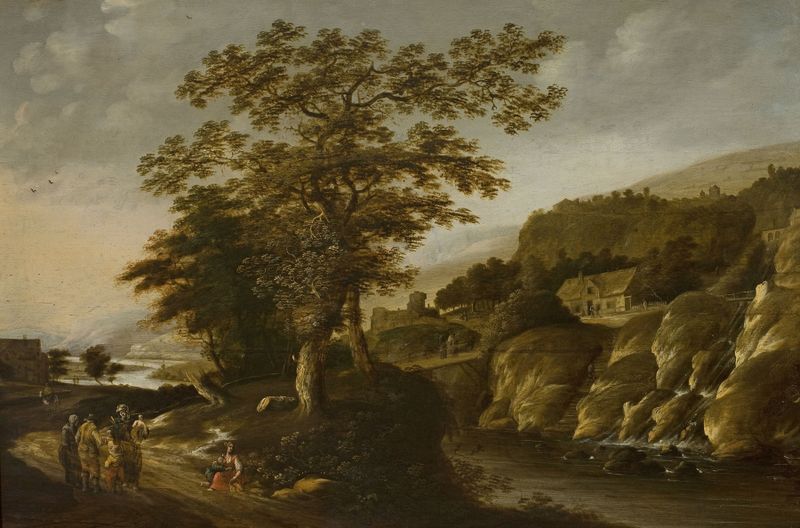
When did color learn to lie? In a world where hues are meant to convey truth, the landscape before us betrays a haunting tension that lingers beneath its vibrant surface. Focus on the rolling hills that sweep across the canvas. Notice how the deep greens of the foliage are interrupted by the stark, menacing grays of the encroaching storm clouds. As your gaze travels upward, the soft, diffused light creates an eerie glow, casting long shadows that stretch ominously over the landscape.
The brushwork is meticulous, lending a sense of movement to the clouds while simultaneously grounding the viewer in the stillness of the valleys below. There’s an unsettling juxtaposition at play here—the beauty of nature countered by a looming fear, as if the storm threatens to extinguish the very life the colors celebrate. Look closely at the edges where light meets dark; it is here that the painter’s intent reveals itself. The vibrant hues of the trees are vibrant yet tinged with an underlying anxiety, suggesting that nature’s splendor can rapidly transform into chaos.
The quiet dread of the landscape speaks volumes about the artist's interpretation of the sublime, capturing both awe and trepidation in the hearts of those who stand before it. Created in 1676, this work emerged during a period of shifting artistic trends in the Netherlands, where realism was on the rise, and landscapes were gaining prominence. Van der Willigen, influenced by the naturalistic styles of his time, sought to infuse his scenes with emotional depth, reflecting both the beauty and the latent fears that nature can evoke. In this masterful portrayal, he navigates between reverence for the landscape and an acknowledgment of its darker potential.