Na de brand van de St.-Michielsabdij — History & Facts
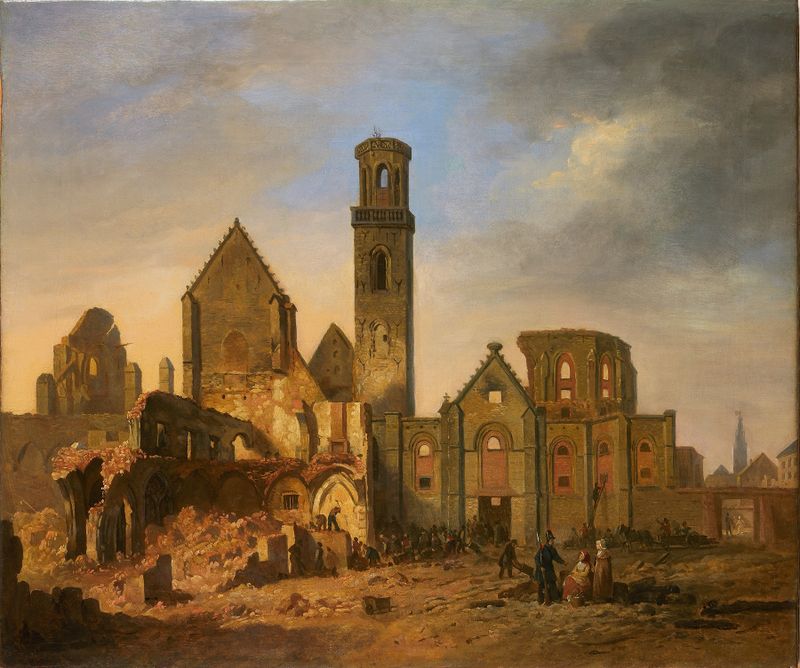
When did color learn to lie? As pigments dance across the canvas, they weave a tale of beauty that hides the darkness beneath. Look to the left, where charred remnants of the St. Michiels Abbey rise against a vivid sky, heavy with swirling blues and reds. Notice how the light refracts off the edges of the flames, creating an eerie glow that both illuminates and obscures the devastation.
The brushwork is restless, capturing the chaotic energy of the moment, while the contrasting hues evoke a haunting beauty that belies the tragedy unfolding below. Amid the destruction lies a profound commentary on the fragility of beauty and faith. The juxtaposition of vibrant skies with the stark ruins speaks to the transience of human achievement, as if to remind us that even the most magnificent structures are susceptible to the ravages of time and fate. Shadows linger in the corners, whispering of loss and sorrow, yet there is an undeniable allure in the way the artist has immortalized this moment, allowing us to glimpse both horror and grandeur in one breath. Philippe Jacques Van Brée created this work in 1832, a time when the echoes of the Romantic movement resonated strongly throughout Europe.
Living in the Netherlands, he sought to capture the emotional landscapes of his subjects, often reflecting on themes of ruin and restoration in the wake of personal and collective loss. This painting emerged during a period of both artistic exploration and turmoil, mirroring the societal shifts of an age that was grappling with the beauty and tragedy of its own history.