
Ontwerp voor een portret omrand door een slang — History & Facts
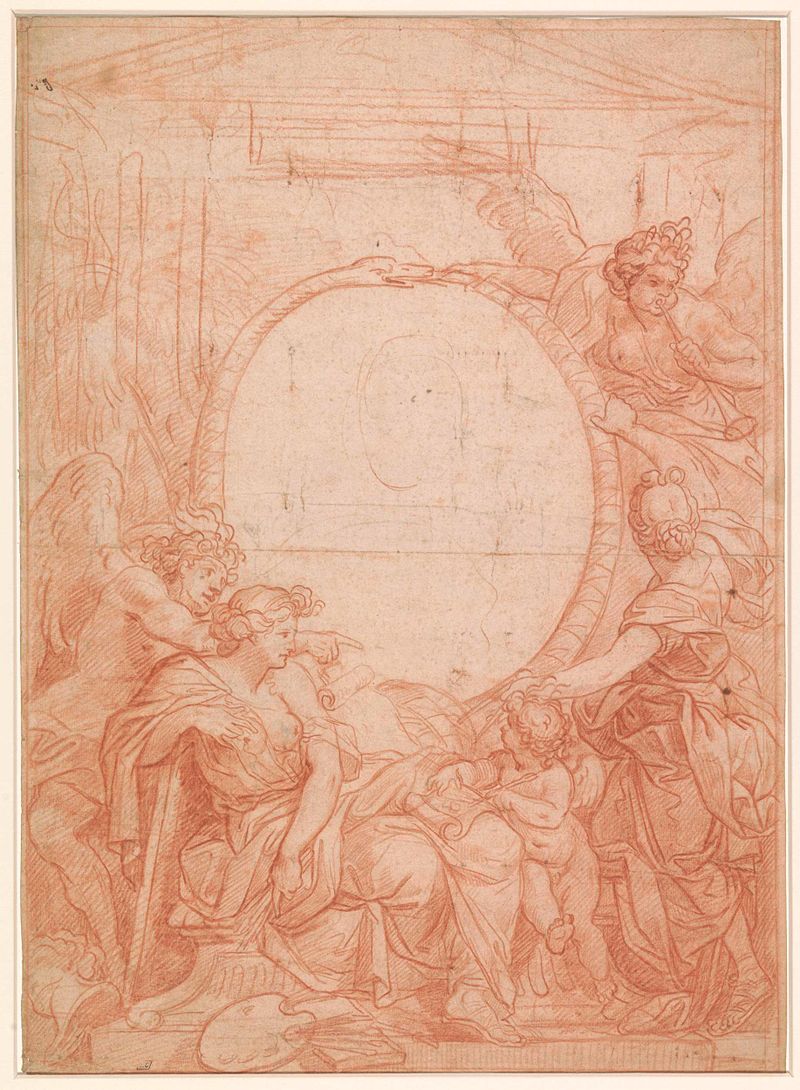
In the delicate interplay of art, divinity finds its form, and chaos is transformed into an emblem of elegance. Look to the center of the composition, where a meticulously rendered face emerges from the swirling lines of a serpent. The contours of the features are softened by a gentle light that bathes the visage, inviting the viewer to explore the intricate details of the expression. Around this central figure, the serpent coils, its scales glistening with rich greens and golds, accentuating the vibrancy of the work.
This juxtaposition of the divine face with the sinuous form of the snake suggests a tension between purity and temptation, a duality that Le Brun masterfully encapsulates. Within this seemingly straightforward design lie deeper layers of meaning. The serpent, often a symbol of wisdom and duality, juxtaposes the serene beauty of the face, hinting at the complexities of human nature. Furthermore, the use of color — the lively greens of the serpent contrasting with the soft skin tones — underscores a dialogue between life and death, creation and destruction.
Each element is not merely decorative but serves to probe the viewer's understanding of divinity and the human condition. Created during a time of artistic flourishing in France, this work reflects Le Brun’s commitment to the grandeur of the human experience. Painted between 1629 and 1690, he was deeply involved in the court of Louis XIV, shaping the visual language of a nation. In this period, Le Brun established himself as a preeminent figure in the Baroque movement, merging classical ideals with a vibrant expressiveness that continues to resonate.
More Artworks by Charles Le Brun
Browse all →
More Portrait Art
Browse all →
Las meninas
Diego Velázquez

Self-portrait with a Bandaged Ear and Pipe
Unidentified artist

Girl with a Pearl Earring
Johannes Vermeer

The Sampling Officials of the Amsterdam Drapers’ Guild, Known as ‘The Syndics’
Rembrandt van Rijn

The Hundred Guilder Print: the man seen on the back in the lower left corner
Rembrandt van Rijn

Portrait of Dr Gachet
Vincent van Gogh