
Ostrihomská bazilika — History & Facts
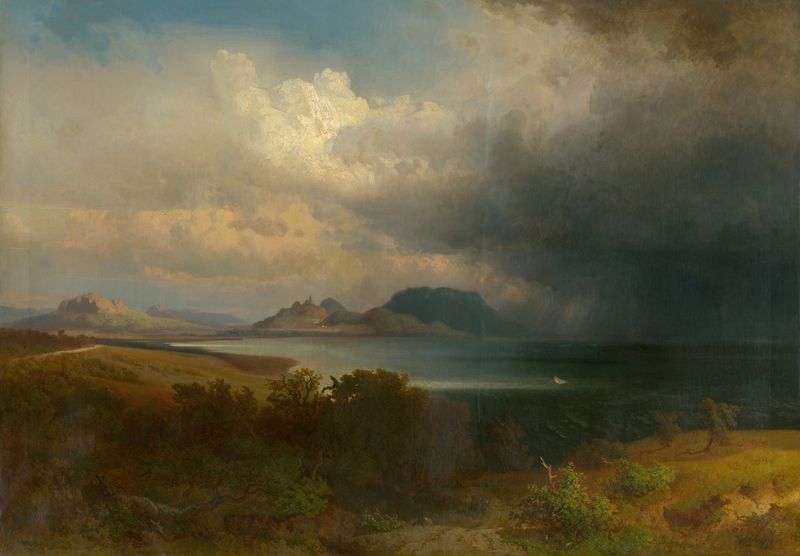
Did the painter know this moment would outlive them? In the stillness of a dream, we find ourselves enveloped by architectural grandeur and ethereal tranquility, whispering secrets of time and faith. Focus on the towering silhouette of the Ostrihomská bazilika, as it dominates the canvas with an imposing yet inviting presence. The artist’s deft brushwork captures the interplay of light cascading over its domed roof, illuminating the intricate details of the façade. Notice how the warm hues of ochre and gold meld seamlessly with the cooler blues of the sky, creating a harmony that both grounds and elevates the structure.
The composition draws the eye upwards, leading us through the archways, where shadow and light dance in a subtle embrace. Beneath this serene exterior lies a tension between the sacred and the temporal. The basilica stands as a testament to enduring faith, yet its solitary stance evokes a sense of isolation against the vastness of the landscape. The dappled light hints at the passage of time, suggesting that while the structure may persist, the moments of joy and sorrow experienced within its walls will forever remain ephemeral.
This juxtaposition invites viewers to contemplate their own place within the continuum of existence, as fleeting as a dream. In 1875, Alexander Brodszky painted this work while living in Hungary, a period marked by a burgeoning national identity amid artistic revival. The country experienced a cultural awakening in the post-revolutionary years, prompting artists to explore themes that resonated with their historical and spiritual context. Brodszky’s focus on monumental architecture reflects this zeitgeist, capturing not just a physical structure, but an enduring symbol of collective memory and aspiration.
More Artworks by Alexander Brodszky
Browse all →


More Architecture Art
Browse all →
The statue of Liberty
Frédéric Auguste Bartholdi

View of Houses in Delft, Known as ‘The Little Street’
Johannes Vermeer

View of Houses in Delft, Known as ‘The Little Street’
Johannes Vermeer

The Cathedral in Rouen. The portal, Grey Weather
Claude Monet

The yellow house
Vincent van Gogh

The Church in Auvers-sur-Oise, View from the Chevet
Vincent van Gogh