Pasture — History & Facts
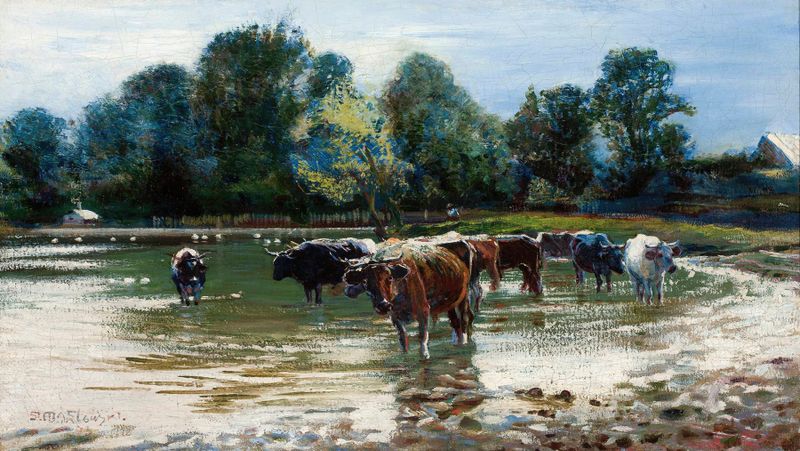
What stories linger in the whispers of the past, patiently held by the brushstrokes of a master? Each detail cradles a memory, a moment frozen in time, urging us to look closer. Focus on the foreground, where vibrant greens of the pasture stretch out under a luminous sky. The brushwork invites a sense of movement, as if the grass sways gently in an unseen breeze. Notice how the light dances across the surfaces, highlighting the rich textures of the land, while shadows deepen in the hollows, creating a compelling contrast that draws the eye further into the scene. Delve into the layers of meaning woven into this landscape.
The open pasture may evoke feelings of solitude, yet it teems with an underlying vibrancy, hinting at life just beyond the frame. Look for the lone figure, perhaps a shepherd or farmer, whose presence suggests a connection to the land — a reminder of humanity’s bond with nature. This figure stands not as an isolated silhouette, but as a symbol of existence within an expansive world, inviting reflection on memory and the passage of time. Stanisław Masłowski painted this piece in 1889, during a period marked by the rise of the Polish artistic movement.
Living in Paris at the time, he was influenced by both the Impressionists and the Symbolists, seeking to capture the essence of landscape and light. The work reflects his dedication to portraying the rural life of Poland, while exploring the delicate interplay of memory and experience amidst the evolving world of art.