
Pavillon auf Dr. Körners Weinberg bei Loschwitz — History & Facts
What if silence could speak through light? In Pavillon auf Dr. Körners Weinberg bei Loschwitz, the luminous interplay of sunlight and shadow whispers tales of destiny intertwined with nature's tranquil embrace. Look to the center of the composition, where the delicate pavilion stands, its soft hues reflecting a gentle harmony with the verdant surroundings. Notice how the artist employs a palette of muted greens and warm earth tones, inviting the viewer into a serene moment in time.
The light, dappled through the leaves, falls gracefully upon the structure, accentuating its architectural elegance while creating an inviting sanctuary amidst the lush foliage. Each brushstroke communicates a sense of peace, urging one to linger in this idyllic setting. Beneath the surface, the painting captures more than just a picturesque scene. The pavilion, a symbol of human aspiration, stands resilient against the vastness of nature, evoking a poignant contrast between mankind's fleeting creations and the timelessness of the natural world.
The gentle curves of the trees cradle the structure, suggesting protection and interconnectedness, while the distant hills hint at a boundless horizon, representing the unknown paths of destiny that lie ahead. Created in 1828, this work emerged during a period of burgeoning Romanticism in Europe, where artists sought to express emotions and capture the sublime beauty of nature. Traugott Faber painted this piece in Germany, reflecting his deep appreciation for the landscapes around him and the philosophical inquiries of the age. It was a time characterized by a search for meaning, as well as an exploration of the relationship between humanity and the natural world.
More Artworks by Karl Gottfried Traugott Faber
Browse all →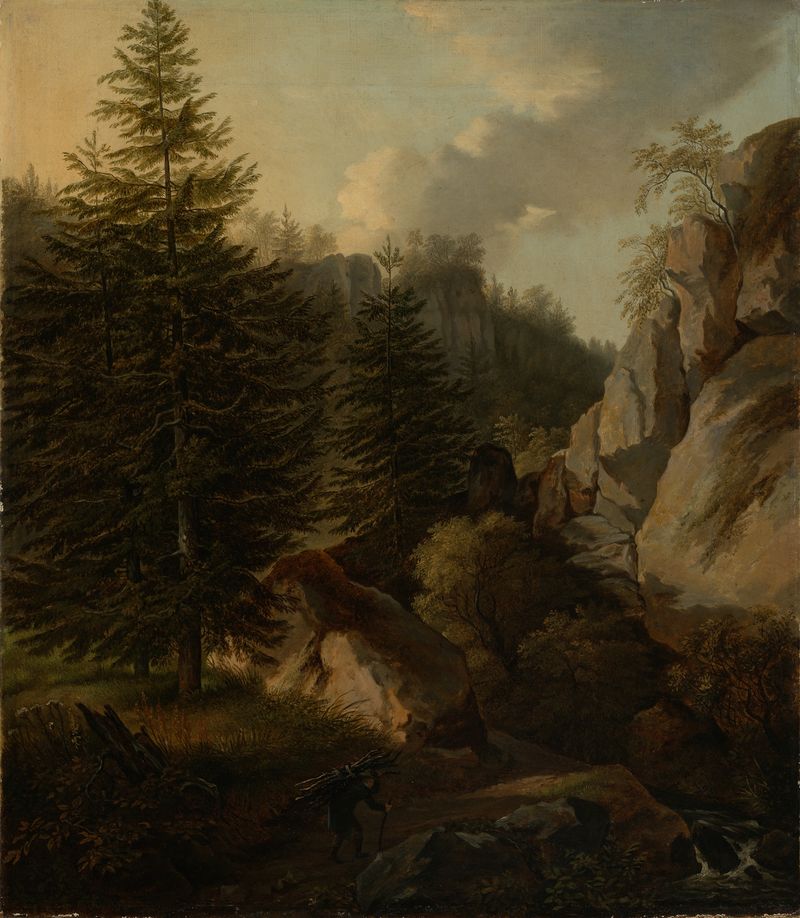
More Architecture Art
Browse all →
The statue of Liberty
Frédéric Auguste Bartholdi

View of Houses in Delft, Known as ‘The Little Street’
Johannes Vermeer

View of Houses in Delft, Known as ‘The Little Street’
Johannes Vermeer

The Cathedral in Rouen. The portal, Grey Weather
Claude Monet

The yellow house
Vincent van Gogh

The Church in Auvers-sur-Oise, View from the Chevet
Vincent van Gogh