Phantastische Ruinenlandschaft mit Denksäule — History & Facts
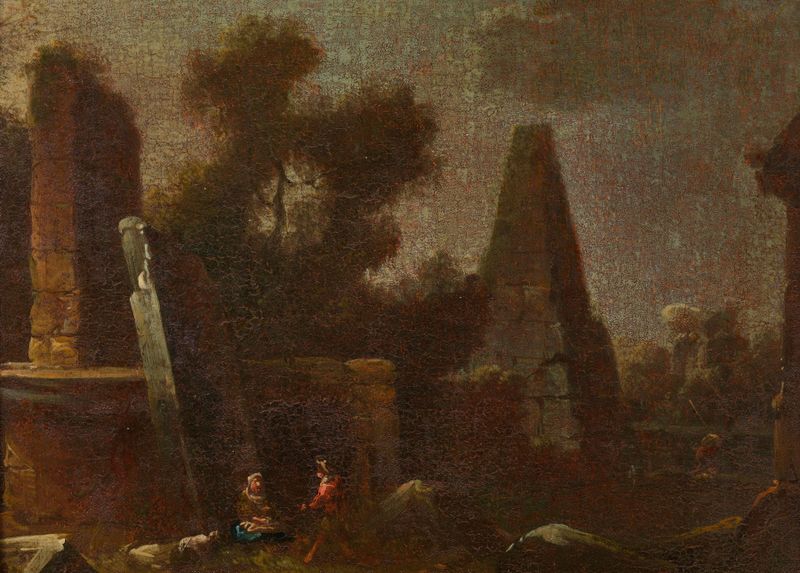
What secret hides in the quiet of the canvas? A sense of fear lingers just below the surface of Phantastische Ruinenlandschaft mit Denksäule, drawing viewers into a world where the past whispers through the ruins of an imagined landscape. Look to the lower right, where crumbling stone and twisted vegetation meet the cool hues of twilight. The palette, dominated by somber greens and grays, evokes the decay of time while the sharply defined forms of the ruins create an unsettling juxtaposition against the hazy atmosphere. Notice how the light dances around the solitary column, illuminating it with an ethereal glow, almost as if it holds a forgotten knowledge waiting to be unearthed.
The composition, meticulously arranged, invites the eye to wander from ruin to ruin, across the ethereal expanse, yet the faint shadows suggest an unseen presence. Within this haunting landscape, contrasts emerge: the delicate beauty of nature entwined with human decay, and the looming silence that engulfs the scene. Every stone carries a story, echoing the tension between history and loss. The column, standing solitary against a backdrop of neglect, symbolizes a forgotten legacy, imbuing the landscape with an unsettling sense of foreboding.
The fear of what once was and what remains unspoken pulses through the canvas, challenging viewers to confront their own reflections on mortality and the passage of time. Canton painted this work between 1700 and 1730, a period marked by an increasing fascination with the sublime and the ruins of antiquity. As a German artist, he found inspiration in the picturesque landscapes of his own surroundings, yet infused them with imagination and emotion. During this era, Europe was recovering from the tumult of religious wars, and a growing interest in nature and its philosophical implications began to emerge in the art world.