
Piazza San Marco and the Campanile, Venice — History & Facts
Can paint confess what words never could? In the vibrant splendor of Venice, a place both breathtaking and tumultuous, the canvas invites us to explore the sharp contrast between beauty and the underlying violence that often lies beneath. Look to the center where the Campanile rises against an azure sky, its form majestic yet imposing. The intricate details of the bell tower are enhanced by the play of light, casting elongated shadows that flutter across the piazza. Notice how the shimmering reflections in the water mingle with the warm tones of the buildings, creating a sense of harmony that is almost deceptive.
The careful brushstrokes evoke movement, drawing the viewer's eye across the bustling scene, where both tourists and locals weave through the open space. Yet, as you linger, a disquiet creeps in. The vibrant colors and lively atmosphere mask deeper tensions, hinting at a history steeped in both grandeur and turmoil. The figures, animated in their interactions, represent not just daily life but the weight of historical violence—wars, conquests, and cultural collisions—that shaped this iconic locale.
Each stroke seems to gasp for a moment between beauty and despair, embodying the duality of Venice itself. Created during a time when the artist sought to capture the essence of his homeland, this work reflects the rich tapestry of Venetian life. Although the precise date remains unknown, Canella was immersed in the artistic currents of 19th-century Italy, a period marked by nationalism and the revival of classical themes in art. His interpretation of this celebrated site reveals how, even amid idyllic settings, the echoes of a turbulent past resonate, urging viewers to confront the complexities behind the charm.
More Artworks by Carlo Canella
Browse all →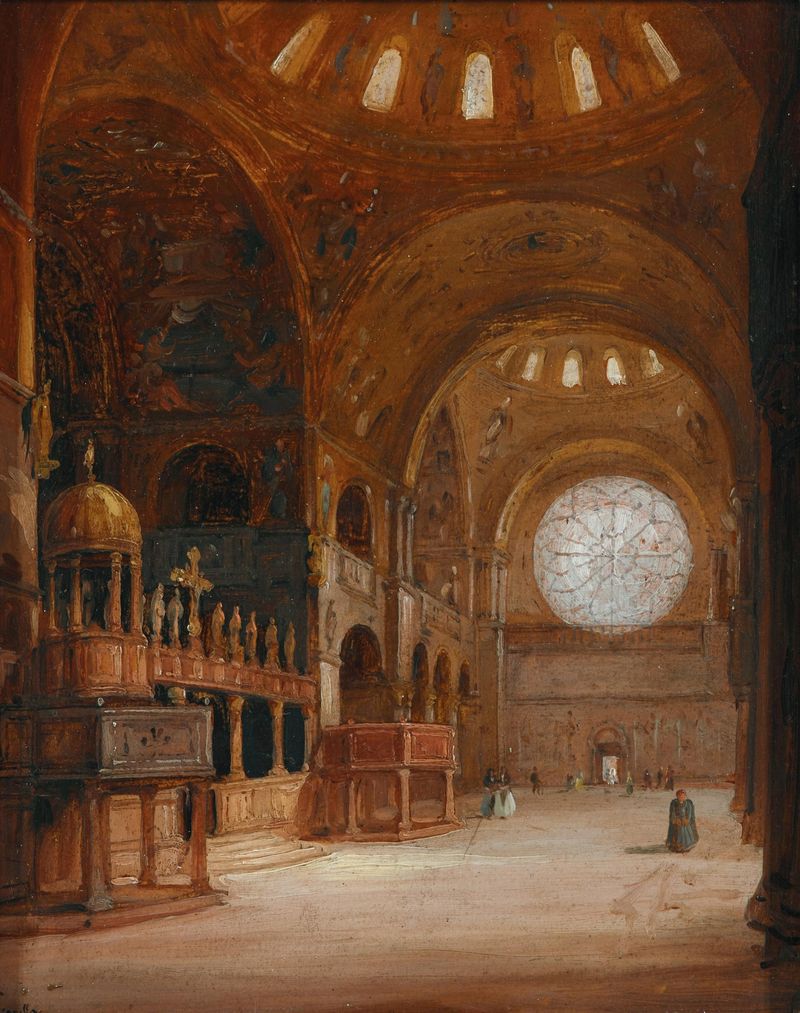

More Architecture Art
Browse all →
The statue of Liberty
Frédéric Auguste Bartholdi

View of Houses in Delft, Known as ‘The Little Street’
Johannes Vermeer

View of Houses in Delft, Known as ‘The Little Street’
Johannes Vermeer

The Cathedral in Rouen. The portal, Grey Weather
Claude Monet

The yellow house
Vincent van Gogh

The Church in Auvers-sur-Oise, View from the Chevet
Vincent van Gogh