
Saint Catherine — History & Facts
In Saint Catherine, the duality of faith and suffering intertwines like the delicate brushstrokes of a master. Here, the beauty of religious devotion is palpable, yet beneath that surface lies a profound tension — the price of unwavering belief. Look to the center of the composition, where the serene visage of Saint Catherine commands attention. Her radiant face, painted with soft hues of ivory and rose, stands out against the rich, dark backdrop.
Notice how the golden halo encircles her head, glinting with a divine light that caresses her features. The intricate detailing of her attire, adorned with vibrant reds and blues, contrasts starkly with the muted tones surrounding her, hinting at her elevated status yet grounding her in the earthly realm. Delve deeper into the symbolism of the wheel beside her. It represents her martyrdom, a striking reminder of the trials she endured for her faith.
The juxtaposition of beauty and suffering manifests in her delicate hands, poised with grace yet hinting at an inner turmoil, as if she is both accepting and resisting her fate. The painter’s deliberate use of light and shadow creates a tension between the ethereal and the corporeal, inviting contemplation on the sacrifices entwined with spiritual devotion. Jean Bellegambe created this work around 1520 in Flanders, a time when the Netherlands was at the forefront of the Northern Renaissance. The period was marked by a growing emphasis on individual spirituality and the questioning of religious norms.
This context influenced Bellegambe’s approach, as he sought to merge intricate detail with deep emotional resonance, capturing the complexities of faith during a time of transformation in both society and art.
More Artworks by Jean Bellegambe
Browse all →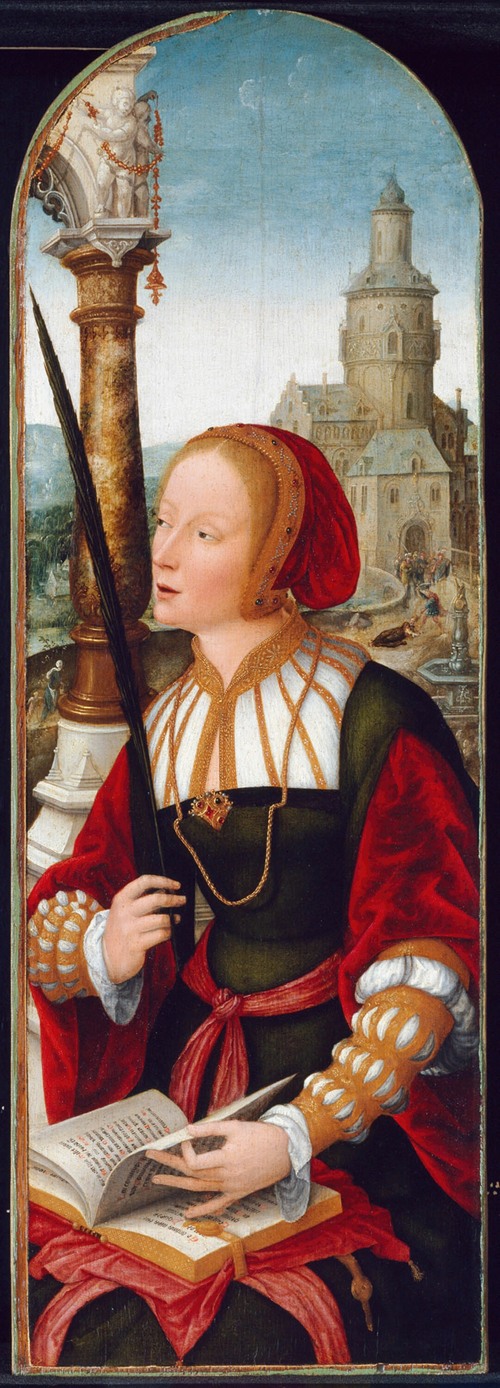
More Religious Art
Browse all →
The Return of the Prodigal Son
Rembrandt van Rijn

The Garden of Earthly Delights
El Bosco

Count Orgaz’ funeral
El Greco

The Hundred Guilder Print: the central piece with Christ preaching, the plate arched
Rembrandt van Rijn

The Descent from the Cross
Rogier van der Weyden

The return of the prodigal son
Rembrandt van Rijn