Salle des armures du musée d'Artillerie à Saint Thomas d'Aquin à Paris — History & Facts
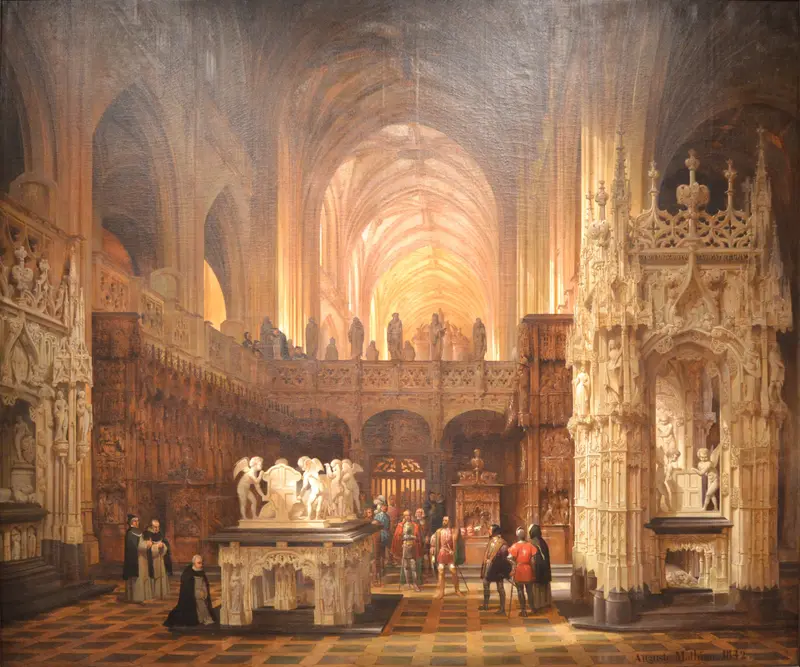
The first thing to catch the eye is the parade of armored knights, frozen mid-charge atop their horses, as if the past has stepped out into the present. These silent riders, gleaming under the high arches, are not living men but displays—effigies of power and chivalry arranged for the gaze of visitors. The painter, Auguste Mathieu, uses the sweep of light from the left to draw us into the vaulted gallery, guiding us past the curious onlookers in their crinolines and uniforms.
The flags and shields on the walls become a tapestry of memory, each artifact a relic of conflict and ceremony, while the living figures seem almost ghostly by comparison, dwarfed by the martial grandeur around them. Painted in 1860, Salle des armures du musée d'Artillerie à Saint Thomas d'Aquin à Paris belongs to a moment when France was both looking back to its medieval heritage and forging a modern identity. The 19th century saw a surge in historical museums and collections, often established by the state to educate and inspire civic pride. Such images were not just records, but celebrations of national history, inviting viewers to contemplate the continuity between past and present.
Little is recorded about this specific work or its commission, but its presence in the Musée de l’Armée collection today hints at the enduring fascination with the spectacle of armor and the rituals of remembrance. Stand before it and you may find yourself drawn, like its painted visitors, into the long shadow of history.