Südliche Küstenlandschaft mit Schafherde — History & Facts
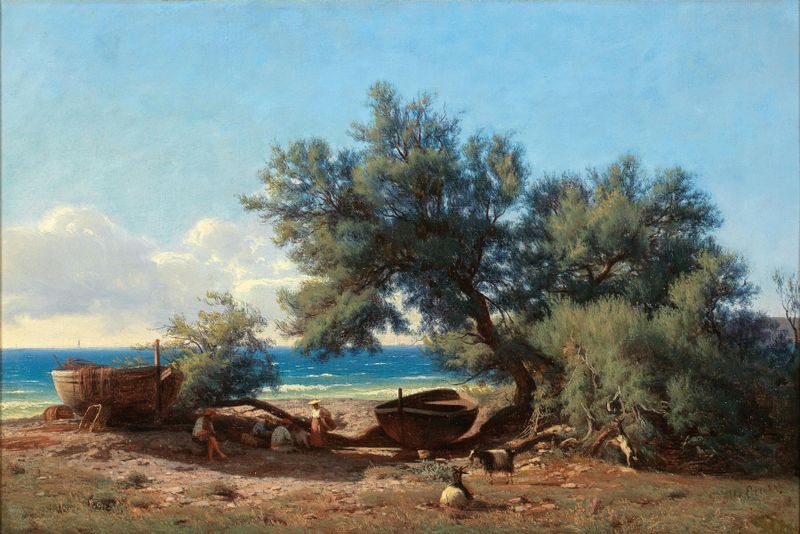
Could beauty survive in a century of chaos? The question lingers like a whisper in the windswept landscape of Südliche Küstenlandschaft mit Schafherde, where tranquility dances delicately on the brink of turmoil. Look to the foreground, where a serene flock of sheep grazes peacefully, their white wool contrasting sharply against the rich greens and earthy browns of the terrain. The gentle undulation of the hills draws the eye upwards, revealing a dramatic coastline in the distance, bathed in golden light. Spiridonovich Erassi’s brushwork captures the fleeting quality of sunlight, creating soft shadows that enhance the pastoral scene's depth, while the palette speaks of warmth and vitality, inviting viewers to linger. Yet beneath this idyllic veneer lies an undercurrent of tension.
The calmness of the sheep, seemingly oblivious to their surroundings, is juxtaposed with the impending cliffs that loom overhead, hinting at the fragility of peace amidst uncertainty. The distant waves, crashing against the rocks, echo a foreboding sense of change, symbolizing the turmoil that might disrupt such beauty. This duality provokes reflections on the resilience of nature, juxtaposed against human conflicts that threaten its very existence. Created during a tumultuous period in the mid-20th century, when Erassi was on the Crimean Peninsula, Südliche Küstenlandschaft mit Schafherde reflects both personal and societal upheaval.
As the world grappled with the complexities of war and violence, the artist sought solace in the landscapes around him, translating the chaos into an exploration of beauty that stands resilient against the shadows of history.