
Slapende jongen — History & Facts
In moments of stillness, we often find the deepest tranquility, a serene landscape within ourselves that can be felt in the quietude of slumber. Focus on the gentle curve of the boy's body, relaxed in repose, as the soft light filters through the delicate folds of his clothing. The artist’s subtle palette of muted earth tones invites the viewer into this intimate moment, highlighting the contours of his face where shadows play with the light. Notice how the background fades softly, almost as if it too is drifting into a dream, allowing the viewer to immerse entirely in the boy’s peaceful state. Yet, beneath this gentle surface lies a profound sense of vulnerability.
The boy, at that moment, is both lost to the world and entirely present in his own serenity—a juxtaposition that reflects the innocence of youth against the harsh realities that await him. The quietude is punctuated by the slight tension in the boy’s clenched hands, hinting at the dreams or worries that flutter just beneath the surface of his slumber, connecting him to a world beyond this serene bubble. In 1837, Charles Brias captured Slapende jongen while navigating the artistic currents of Romanticism, a period emphasizing emotion and individual experience. Living in Belgium, he was influenced by the emerging focus on realism and the portrayal of everyday subjects, seeking to create an emotional resonance that transcended the mere representation of life.
This work stands as a testament to his ability to encapsulate a fleeting moment of peace amidst the tumult that defined the age.
More Artworks by Charles Brias
Browse all →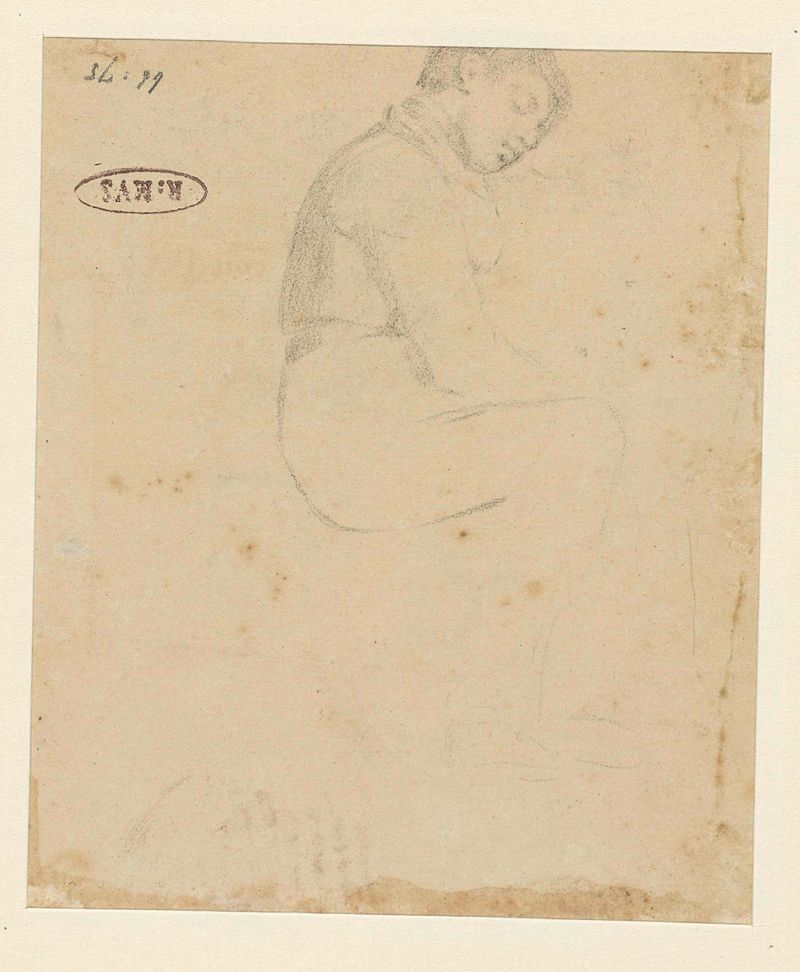
More Portrait Art
Browse all →
Las meninas
Diego Velázquez

Self-portrait with a Bandaged Ear and Pipe
Unidentified artist

Girl with a Pearl Earring
Johannes Vermeer

The Sampling Officials of the Amsterdam Drapers’ Guild, Known as ‘The Syndics’
Rembrandt van Rijn

The Hundred Guilder Print: the man seen on the back in the lower left corner
Rembrandt van Rijn

Portrait of Dr Gachet
Vincent van Gogh