Springtime and Love — History & Facts
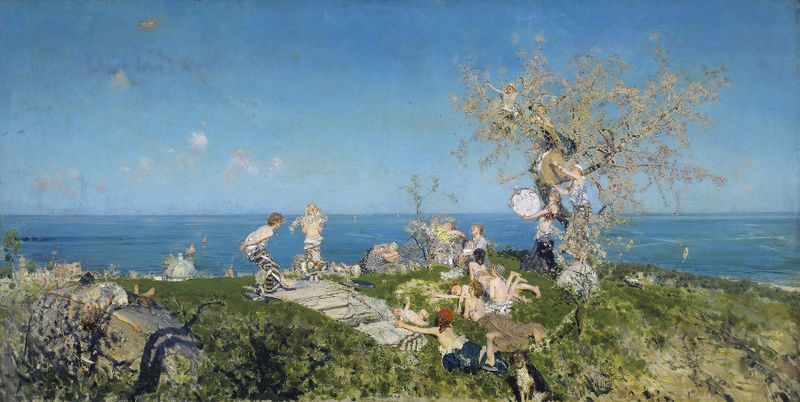
Could beauty survive in a century of chaos? In Springtime and Love, the answer resonates with a soft, hopeful sigh, inviting the viewer to embrace the tender allure of human connection amidst uncertainty. Focus on the couple at the center, entwined in a moment of quiet intimacy, their gazes tender and locked together. The artist employs a warm palette, with soft greens and blooming pinks, creating a lush landscape that seems to breathe with life. The light dances delicately around their figures, highlighting their expressions and casting gentle shadows that merge with the surrounding nature.
Notice how the vibrant blossoms frame their love, turning the scene into a sanctuary of joy and renewal. Yet, within this idyllic portrayal lies an undercurrent of tension. The couple's closeness juxtaposed against the expansive, wild landscape hints at the fragility of such moments, as if love can flourish amidst the chaos but remains vulnerable. The fluttering flowers symbolize not only spring's rebirth but also the ephemeral nature of happiness — beautiful yet fleeting.
Each brushstroke tells a story of hope, suggesting that love can thrive even when the world outside is tumultuous and uncertain. Francesco Paolo Michetti painted Springtime and Love in 1878, during a time when Italy was experiencing political upheaval and a search for national identity. Living in Abruzzo, Michetti was deeply influenced by the regional landscapes and the lives of its people. This work reflects his belief in the power of love and beauty as a refuge, capturing a moment of peace and connection against the backdrop of a transforming society.