Still Life — History & Facts
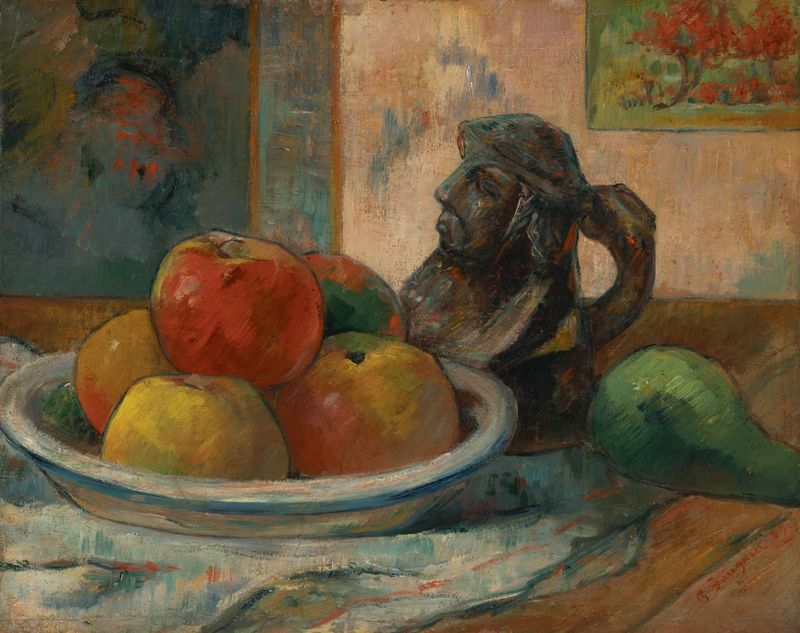
Could beauty survive in a century of chaos? This question lingers as we gaze upon the delicate arrangement of muted tones and gentle forms in an exquisite still life, where the ephemeral beauty of life meets the inevitability of decay. Look to the center of the composition, where a bowl of fruit rests casually, yet purposefully, against a softly draped cloth. Notice how the light bathes the apples and pears, casting subtle shadows that invite your eye to linger. The muted palette, dominated by earthy greens and soft browns, evokes a sense of warmth and melancholy, while the gentle brushstrokes blur the boundaries of forms, merging them into a harmonious whole that speaks to the fragility of existence. Within this serene tableau lies a profound tension between vitality and deterioration.
The fruit, seemingly fresh and inviting, carries with it an undertone of impending decay, a reminder of the transient nature of beauty. The draped cloth, too, with its creases and folds, hints at the passage of time, reinforcing the idea that all things, no matter how lovely, are subject to the relentless grip of mortality. Each detail, from the delicate sheen on the fruit to the soft play of light, echoes the artist's contemplation on life’s fleeting moments. Eugène Carrière painted this work around 1875, during a time when France was grappling with social and political upheaval.
While the art world was experiencing the influence of Impressionism, Carrière’s focus on ethereality and introspection marks a departure from the vibrant dynamics of his contemporaries. In this still life, he encapsulates a moment of quiet reflection, inviting viewers to ponder the deeper connections between beauty and transience in an era rife with chaos.