Still Life with Fruit and Chestnuts — History & Facts
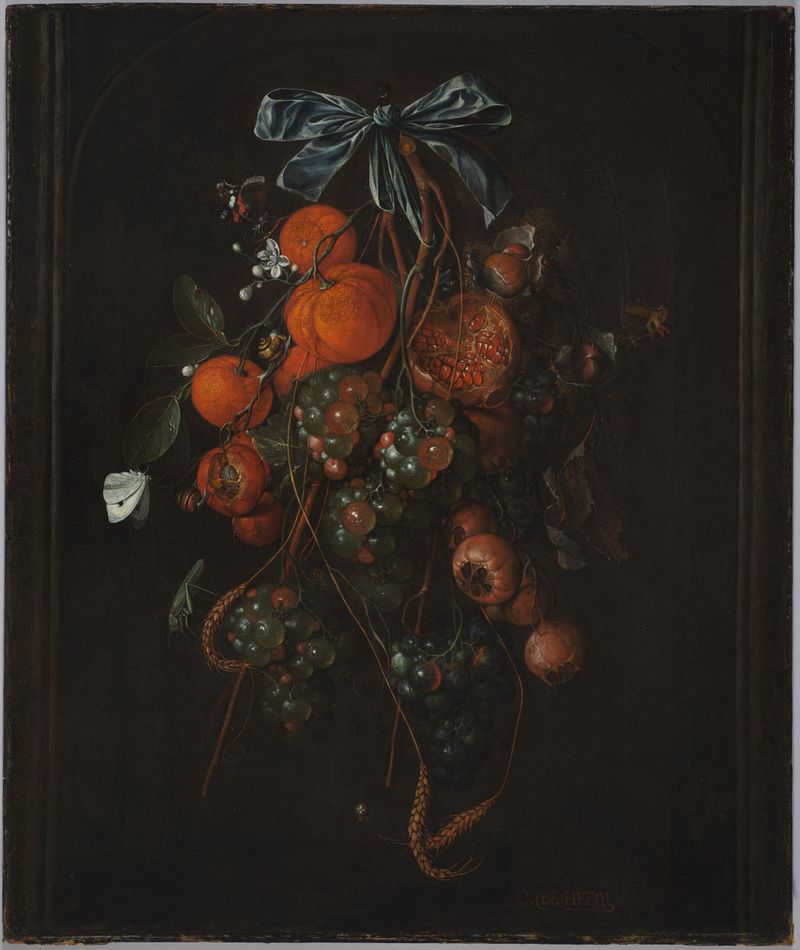
In Still Life with Fruit and Chestnuts, light dances over meticulously arranged objects, illuminating not only their forms but also the ephemeral nature of existence. Look to the right at the vibrant oranges and deep reds of the fruits, where a radiant glow captures their texture and ripeness. Notice how the soft brushstrokes create a sense of three-dimensionality, while shadows intertwine softly with the highlights, suggesting both warmth and a fleeting moment. The chestnuts, nestled among the foliage, invite the viewer’s gaze to linger, their glossy surfaces reflecting the light in rich contrast to the muted greens and browns of the background. As your eyes traverse the canvas, consider the tension between abundance and decay.
The fruit, ripe and inviting, symbolizes life's richness, while the chestnuts, with their rough exterior, hint at the bittersweet passage of time. The interplay of light and dark not only embodies the physicality of the objects but also evokes a deeper reflection on mortality and transience. In the mid-17th century, Cornelis de Heem painted this piece in the Netherlands, a time when still life became a flourishing genre, capturing the curiosity of collectors and scholars. The artist was known for his masterful play with light and texture, as well as his ability to infuse ordinary objects with profound meaning.
This work reflects both his personal style and the broader artistic movement of the time, where the celebration of life's fleeting moments gained newfound appreciation.