Summer Landscape at Sunset — History & Facts
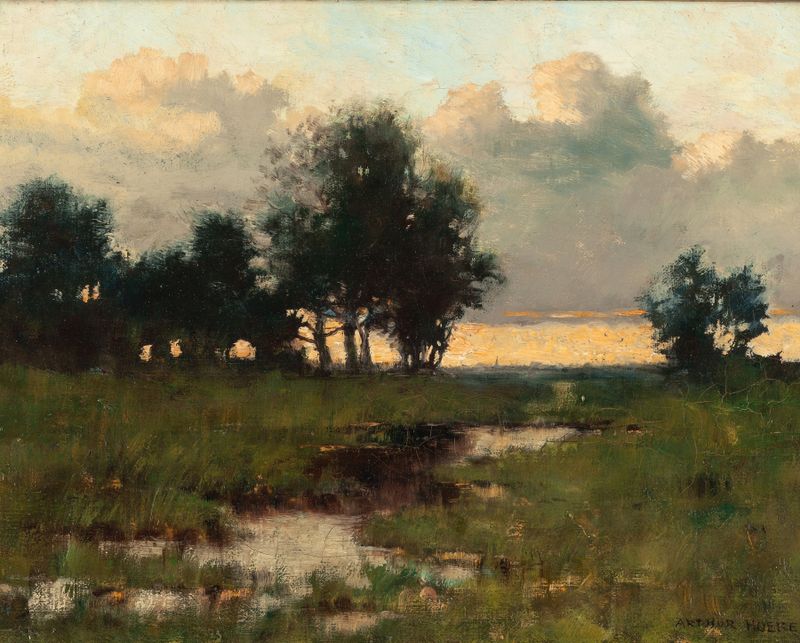
In a world overwhelmed by noise, the tranquil embrace of nature offers a space for reflection and revelation. It invites us to pause and contemplate the beauty hidden within fleeting moments, urging us to listen to the whispers of the landscape. Look to the left at the deep greens of the trees, their rich hues contrasting beautifully with the warm golds and oranges of the setting sun. The sky, a canvas of swirling colors, suggests both chaos and harmony.
Notice how the brushstrokes play with the light, creating a sense of movement that breathes life into the scene. Each element is carefully composed, drawing the viewer’s eye across the canvas, inviting exploration of the subtle details nestled within the vast expanse. Beyond the immediate beauty lies a deeper narrative. The gentle transition of light signifies a shift in the day, a metaphor for the fleeting nature of time itself.
The contrasts between the vibrant sky and the shadowed earth evoke a sense of duality, where joy and melancholy coexist. Here, the silence of the landscape speaks volumes, revealing unspoken thoughts that linger in the air, offering a sanctuary for introspection. Arthur Hoeber painted this piece during a time when American art was embracing Impressionism and exploring the depths of natural beauty. Active in the early 20th century, he was part of a movement that sought to capture the ephemeral qualities of light and atmosphere.
Amidst a rapidly changing world, his work reflects not only personal contemplation but also a collective yearning for tranquility in nature’s embrace.