Summer Night — History & Facts
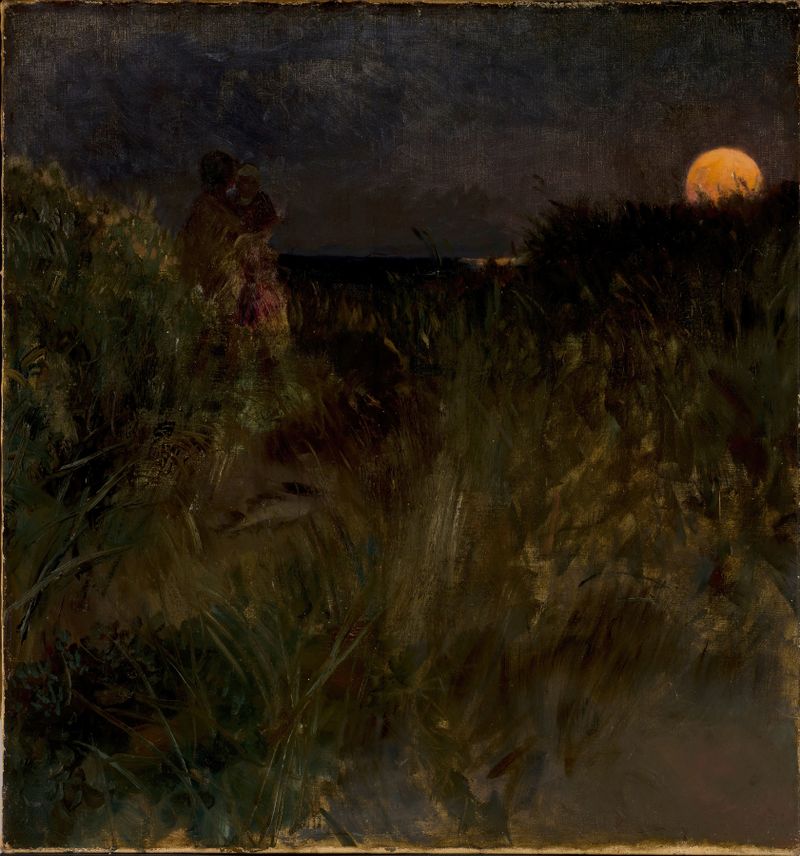
Can paint confess what words never could? In Summer Night, the quiet embrace of twilight whispers secrets that linger long after the sunset has faded. Each brushstroke evokes a profound longing, as if the canvas captures not only a moment but an entire world of nostalgia. Look to the left, where swathes of deep blue and violet meld seamlessly into the horizon, the fading light giving way to a symphony of stars. Notice how the golden glow emanates from the quaint cottages, their windows flickering like the heartbeat of a sleeping village.
The contrasting colors—cool blues juxtaposed with warm yellows—create a gentle tension, inviting the viewer into a realm steeped in calm yet charged with unspoken stories. As you explore deeper, consider the figures framed by the trees, their silhouettes blending into the background. They seem to dissolve into the landscape, suggesting a fleeting moment of connection with nature and each other. The stillness of the scene hints at nostalgia, evoking memories of summers past, while the soft brushwork conveys the ephemeral nature of time itself, underscoring a longing for what was and what can never return. Eilif Peterssen painted this piece in 1886 while living in Norway, a period marked by the rise of national romanticism in art.
As the world outside was rapidly industrializing, artists like him turned to nature for inspiration, seeking solace and beauty in the simplicity of rural life. This painting stands as a testament to that era, capturing both the physical landscape and an emotional landscape ripe with reminiscence.