
Synagogue — History & Facts
In a world of fleeting moments and forgotten places, how do we preserve the echoes of our past? As you gaze upon this artwork, begin by focusing on the intricate architectural details that draw your eye toward the central dome, adorned with delicate geometric patterns. The play of light and shadow dances across the surfaces, creating a sense of depth and inviting you to explore the layers of history embedded within the walls. Notice the rich hues of ochre and deep blue, which resonate with both reverence and nostalgia, enhancing the sacred atmosphere of the space. Delve deeper into the composition, where each element serves as a reflection of cultural heritage and spirituality.
The juxtaposition of the softly illuminated interior against the darker, more imposing exterior evokes a tension between the warmth of community and the weight of tradition. Subtle intricacies in the ornamentation symbolize the melding of art and faith, revealing a dialogue between human creativity and divine influence. This is not merely a depiction of a building; it is a testament to the resilience of memory and the significance of shared spaces. Wacław Józef Koniuszko painted Synagogue after 1885, during a time when he was immersed in his exploration of religious and architectural themes.
Living in a period marked by cultural shifts and the rise of nationalism, he sought to capture the essence of Jewish life and tradition at a time when these narratives were often overlooked. His work reflects not only his personal journey as an artist but also the broader socio-cultural landscape of Eastern Europe in that era.
More Artworks by Wacław Józef Koniuszko
Browse all →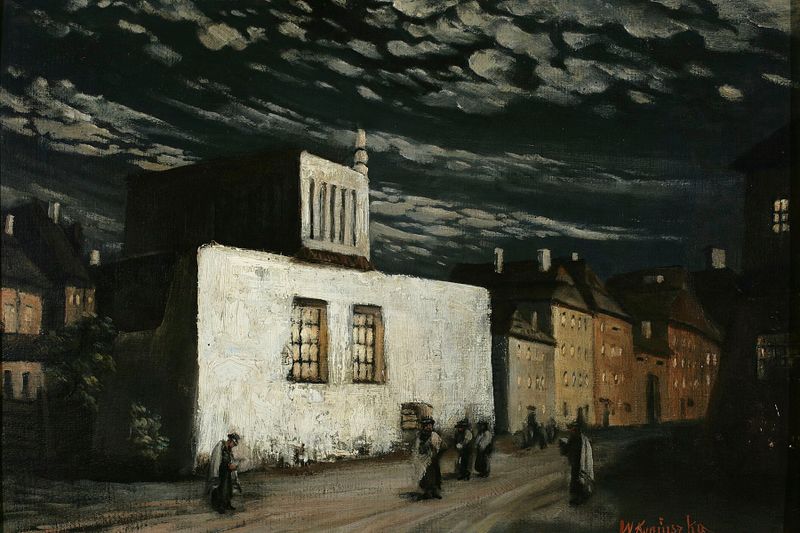
More Architecture Art
Browse all →
The statue of Liberty
Frédéric Auguste Bartholdi

View of Houses in Delft, Known as ‘The Little Street’
Johannes Vermeer

View of Houses in Delft, Known as ‘The Little Street’
Johannes Vermeer

The Cathedral in Rouen. The portal, Grey Weather
Claude Monet

The yellow house
Vincent van Gogh

The Church in Auvers-sur-Oise, View from the Chevet
Vincent van Gogh