
The Castle of Batavia — History & Facts
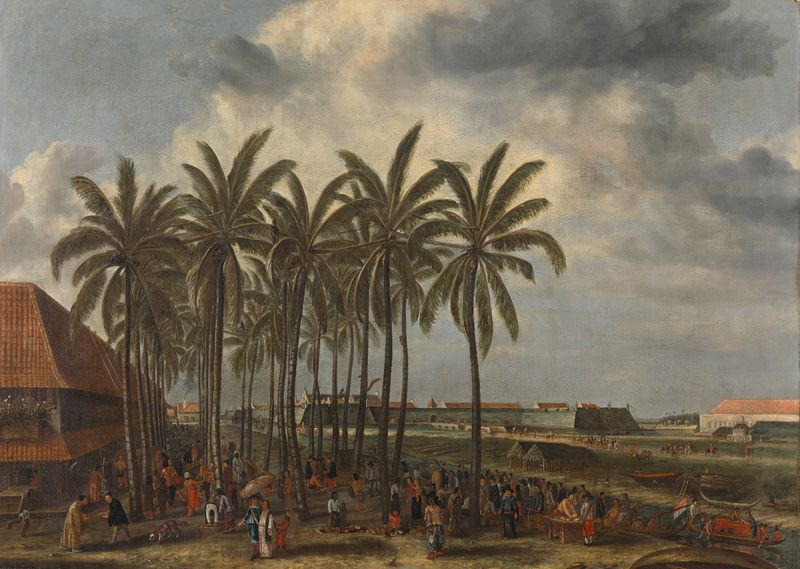
Where does light end, and longing begin? In the ethereal world captured here, the boundaries between the tangible and the elusive blur, echoing the artist’s obsession with both place and memory. Look to the left at the imposing structure of the castle, its rugged stones bathed in a golden light that gives the scene a sense of timelessness. The artist employs a soft palette, where gentle hues of orange and ochre intermingle with the blue of the waterway, creating a serene yet haunting atmosphere. Notice how the clouds drift lazily above, their reflections shimmering in the water below, drawing your gaze towards the horizon—a suggestion of infinite longing.
Each brushstroke conveys both detail and depth, pulling the viewer into a moment suspended in time. Delve deeper into the painting’s contrasts; the sturdy castle stands resolute against the fluidity of the water, embodying the tension between permanence and transience. The distant figures rowing toward the structure hint at human ambition and the relentless pursuit of dreams, while the quiet solitude of the scene speaks to the yearning that often accompanies such aspirations. This duality between hope and melancholy resonates, inviting contemplation of what it means to reach for an intangible ideal. In the early 1660s, the artist was immersed in a period of personal exploration and a burgeoning interest in landscape painting.
Working in the Netherlands during a time of economic and artistic flourishing, he sought to capture not just the visible world but the emotions that dwell within it. The Castle of Batavia reflects both his technical mastery and deep-seated fascination with the interplay of light and longing, marking a significant moment in his artistic journey.
More Artworks by Andries Beeckman
Browse all →
More Architecture Art
Browse all →
The statue of Liberty
Frédéric Auguste Bartholdi

View of Houses in Delft, Known as ‘The Little Street’
Johannes Vermeer

View of Houses in Delft, Known as ‘The Little Street’
Johannes Vermeer

The Cathedral in Rouen. The portal, Grey Weather
Claude Monet

The yellow house
Vincent van Gogh

The Church in Auvers-sur-Oise, View from the Chevet
Vincent van Gogh