
The Fishmonger’s Almhouses, Newington Butts, London — History & Facts
Each brushstroke can resurrect a moment, breathing life into the remnants of the past. In The Fishmonger’s Almhouses, Newington Butts, London, the artist captures not just a place but a sense of rebirth, inviting the viewer to witness what once thrived. Look first to the harmonious arrangement of the almhouses, their weathered facades standing resilient against the backdrop of a burgeoning city. Bright greens and earthy browns define the architecture, while delicate shades of blue peek through the windows, suggesting life within.
The soft light filters through the scene, illuminating the textures of the brick and the intricate details of the rooftops, grounding this historical landscape in a moment suspended in time. Emotional tension arises from the juxtaposition of decay and vibrancy. The faded walls tell stories of endurance, contrasted against the lively market scene nearby, where fishmongers display their bountiful catch. This stark contrast embodies the cycle of life and death, hinting at the community's reliance on both nature and industry for survival.
Each figure captured in motion reveals a pulse of activity, reminding us that from remnants, new stories emerge. Robert Bremmel Schnebbelie painted this work in 1819, a time when London was undergoing significant transformation amidst the industrial revolution. Living in the heart of this bustling city, the artist found inspiration in the everyday scenes that surrounded him. As society shifted and evolved, he sought to preserve the essence of the past even as it faded away, crafting a visual testament to the resilience of human spirit and community.
More Artworks by Robert Bremmel Schnebbelie
Browse all →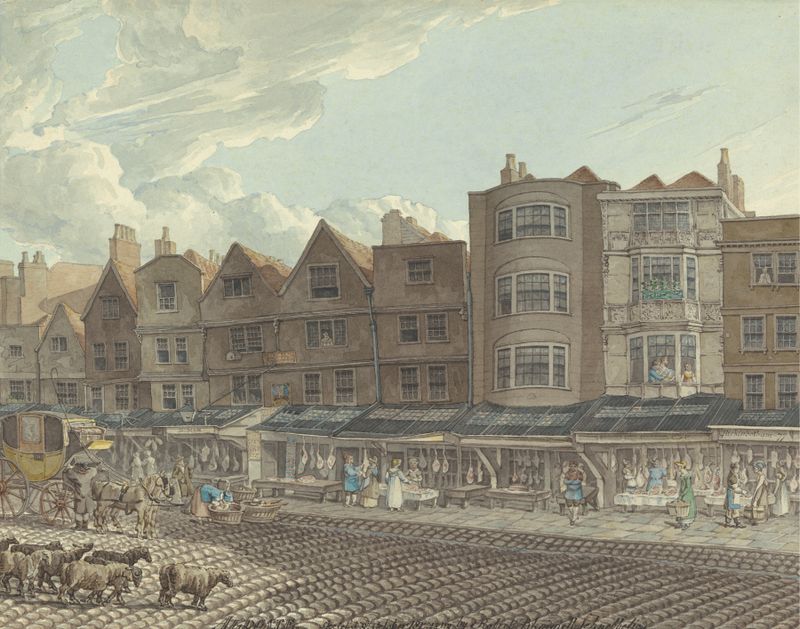
More Architecture Art
Browse all →
The statue of Liberty
Frédéric Auguste Bartholdi

View of Houses in Delft, Known as ‘The Little Street’
Johannes Vermeer

View of Houses in Delft, Known as ‘The Little Street’
Johannes Vermeer

The Cathedral in Rouen. The portal, Grey Weather
Claude Monet

The yellow house
Vincent van Gogh

The Church in Auvers-sur-Oise, View from the Chevet
Vincent van Gogh