
The Good Samaritan — History & Facts
Where does light end, and longing begin? In The Good Samaritan, the interplay of shadow and illumination invites us into a profound dialogue about empathy and fear. Focus first on the central figure, the Samaritan, whose outstretched hand reaches toward the wounded man. Notice how the warm light envelops him, accentuating the tenderness of his gesture. The contrasting dark hues cast shadows over the background, emphasizing the desolation of the scene.
Each character’s expression adds depth: the Samaritan’s compassion juxtaposes with the suffering of the fallen traveler, creating a palpable tension that resonates between hope and despair. Delve deeper into the subtle details—a splatter of blood on the ground signifies violence and vulnerability, a reminder of the cost of caring in a harsh world. The Samaritan’s cloak, rendered in rich tones, symbolizes both his humanity and the burdens he bears when choosing to act against indifference. This delicate balance between light and dark speaks not only of the physical struggle but also hints at the inner conflicts of moral duty, risking oneself for the sake of another. In the years following 1633, Savery was navigating an evolving artistic landscape in the Dutch Baroque period, where themes of morality and human emotion gained prominence.
During this time, the art world increasingly embraced narratives that explored societal values and individual choices. Savery, influenced by these shifts, captured a moment that reflects both the challenges of his day and timeless themes of compassion and fear.
More Artworks by Salomon Savery
Browse all →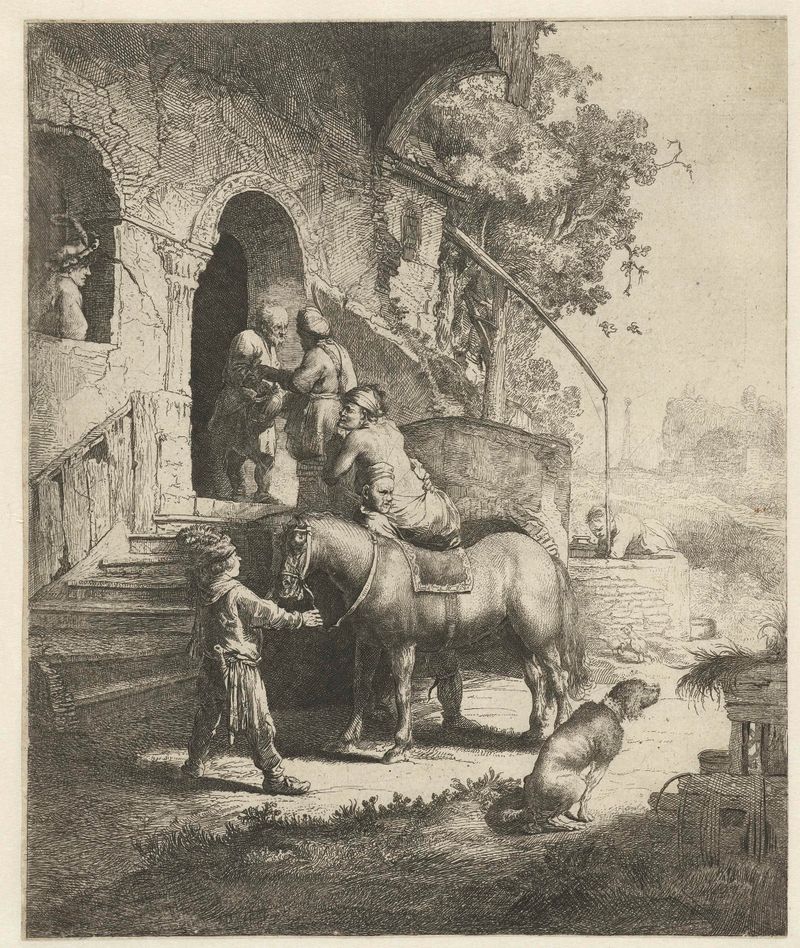
More Religious Art
Browse all →
The Return of the Prodigal Son
Rembrandt van Rijn

The Garden of Earthly Delights
El Bosco

Count Orgaz’ funeral
El Greco

The Hundred Guilder Print: the central piece with Christ preaching, the plate arched
Rembrandt van Rijn

The Descent from the Cross
Rogier van der Weyden

The return of the prodigal son
Rembrandt van Rijn