
The Heiligewegpoort in Amsterdam — History & Facts
In every brushstroke, desire lingers like a whisper of lost moments, begging for eternal recognition. Look to the foreground, where the Heiligewegpoort stands resolutely, framed against a tapestry of muted earth tones that evoke a sense of history. Notice how the delicate interplay of light and shadow dances across its stone facade, revealing textures that seem to breathe. The composition draws your eye upward toward the azure sky, where clouds drift lazily, reminding us of the passage of time—an unyielding force that contrasts with the stability of the gate itself. Amidst the architectural grandeur, small figures dot the canvas, each lost in their own world, embodying the longing for connection or escape.
Their movements are almost spectral, hinting at stories untold, of comings and goings that reflect a deeper yearning for something more. The juxtaposition of the sturdy gate and the ephemeral presence of people captures the essence of desire—rooted in place yet reaching for the intangible. Jan van Kessel created this work during a period of artistic transition in the Netherlands, where the Baroque style began to merge with new perspectives on realism. The exact date remains uncertain, yet it was an era rich with vibrant life and cultural flourishing.
The artist, inspired by the urban landscape of Amsterdam, sought to capture not just architecture but the profound desires that echoed within its streets.
More Artworks by Jan van Kessel
Browse all →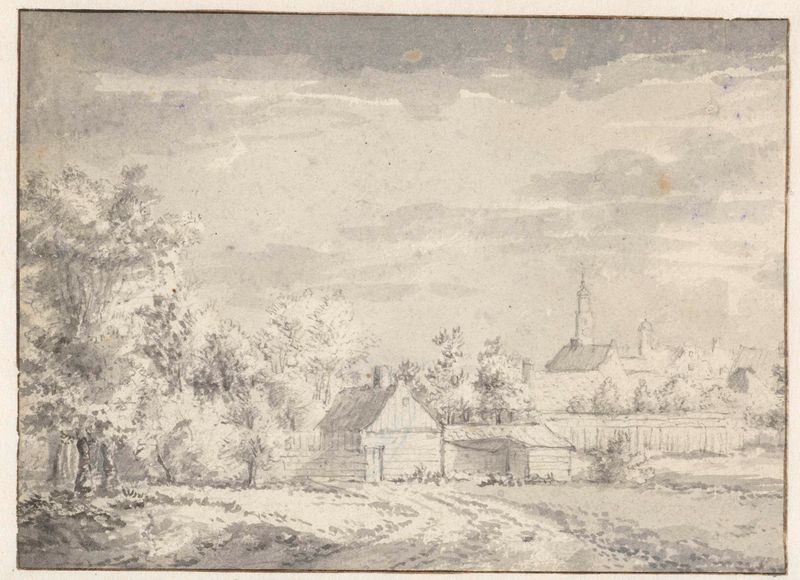
More Architecture Art
Browse all →
The statue of Liberty
Frédéric Auguste Bartholdi

View of Houses in Delft, Known as ‘The Little Street’
Johannes Vermeer

View of Houses in Delft, Known as ‘The Little Street’
Johannes Vermeer

The Cathedral in Rouen. The portal, Grey Weather
Claude Monet

The yellow house
Vincent van Gogh

The Church in Auvers-sur-Oise, View from the Chevet
Vincent van Gogh