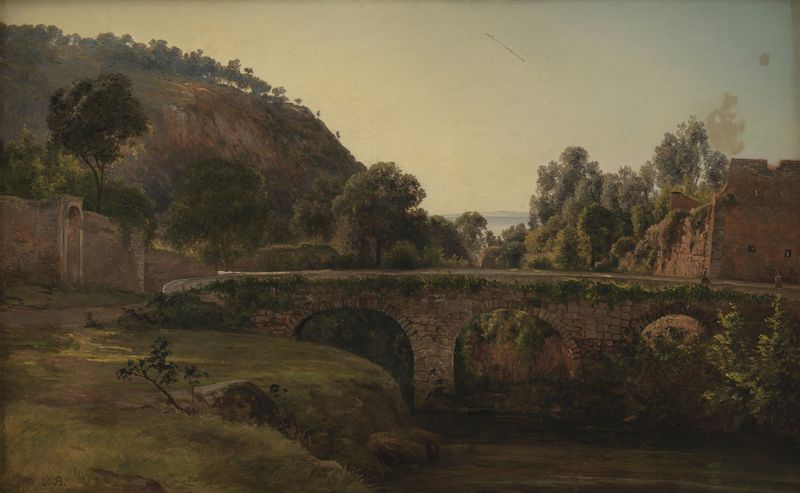
The Ruins of the Antique Theatre at Tusculum, Italy — History & Facts
Could a single brushstroke hold eternity? In The Ruins of the Antique Theatre at Tusculum, Italy, the fragility of time itself is captured through a delicate interplay of form and decay. Look to the left at the way the sunlight caresses the worn stones, illuminating their textures while casting deep shadows that hint at forgotten stories. Notice the soft hues of ochre and faded greens, where nature reclaims its hold on ancient architecture, whispering secrets of a bygone era. The composition draws the eye through the crumbling arches, leading to a distant horizon where the sky meets the land, offering a sense of hope amidst desolation. In this painting, the contrast between the enduring structure and its inevitable disintegration speaks to the transience of human achievement.
The scattered wildflowers creeping through the ruins symbolize resilience and beauty, amplifying the emotional tension between reverence for history and the harsh reality of time’s passage. Each brushstroke seems to hold a memory, inviting contemplation on what remains and what is lost, while the distant mountains loom like silent witnesses to the cycle of creation and decay. Created in 1848, during a time of great artistic exploration and a burgeoning Romantic movement, the artist found inspiration in the ruins of Italy, a testament to civilization's past glory. Brendstrup's choice to focus on the remnants of antiquity reflects the Romantic era's preoccupation with nature and the sublime, encapsulating both a personal reflection on mortality and a broader commentary on the ephemerality of human endeavors in a rapidly changing world.