The serenade — History & Facts
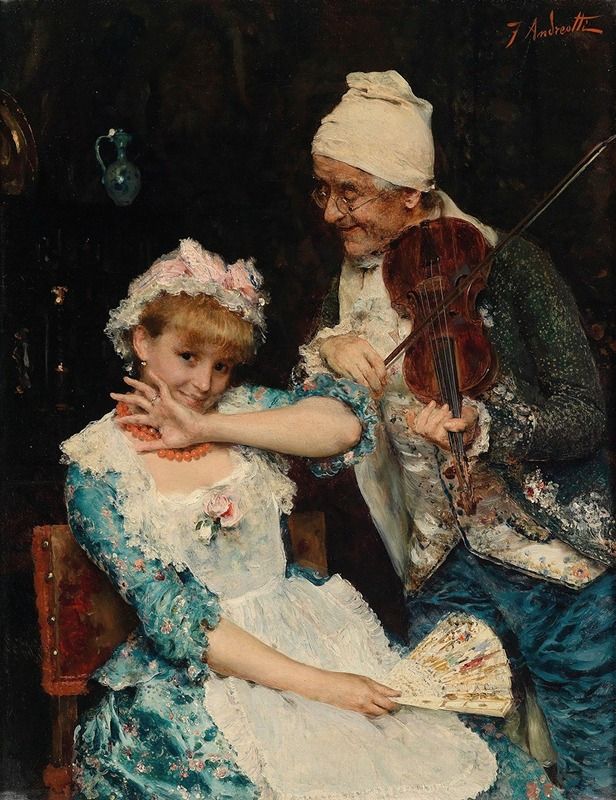
Could beauty survive in a century of chaos? In The Serenade, the artist captures a moment where music transcends the turmoil of reality, allowing grief to morph into solace through art. Look to the left at the elegantly draped figure of a woman, her gaze lost in the distance while her fingers lightly brush the strings of a lute, a gesture that suggests both longing and contemplation. The warm hues of the sunset illuminate her face, casting a soft glow that contrasts with the cooler tones of the surrounding environment. The spatial arrangement draws the eye toward a gentle interplay of light and shadow, emphasizing the emotional gravity of her solitude amid the gathering dusk. Upon closer inspection, the subtle tension becomes apparent.
The serene expression on the woman’s face belies a deeper layer of sorrow—perhaps a reminiscence of love or a haunting loss. The musicians behind her, caught in their own reverie, serve as a backdrop to her introspection, their movements almost ghostlike in the fading light. This subtle juxtaposition of the active and passive invites questions about connection and isolation, evoking a profound sense of empathy in the viewer. Federico Andreotti painted this work in 1900, during a period marked by significant social and artistic upheaval.
Living in Italy, he was immersed in the end of the Belle Époque, a time when traditional art was giving way to modernism. His focus on emotional narrative through classical forms reflects a desire to capture the fleeting beauty of life, even as the world around him was on the brink of chaos.