
The Tomb of Cecaelia Metella — History & Facts
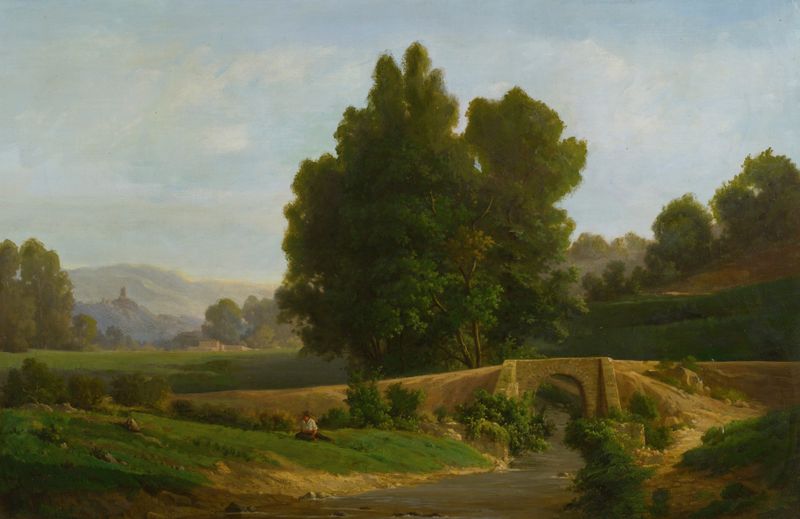
Can beauty exist without sorrow? In The Tomb of Cecaelia Metella, the haunting elegance of decay and the whispers of history intertwine, revealing the duality of existence. Look to the left, where the weathered stone of the tomb emerges from a backdrop of verdant foliage. The artist meticulously captures the interplay of light and shadow, illuminating the intricate carvings that adorn the tomb while allowing the surrounding greenery to fall into a soft obscurity. The use of muted earth tones creates a serene yet melancholic atmosphere, encouraging the viewer to contemplate the passage of time that has sculpted both nature and monument. Hidden within the artwork's stillness are threads of emotional tension: the juxtaposition of the tomb's strength against the fragility of the surrounding life, and the spectral presence of history that haunts its beauty.
The solitary figure in the foreground, with their posture hinting at a moment of reflection or mourning, serves as a poignant reminder of the inevitable cycle of life and death. Each detail, from the cracked stone to the vibrant leaves, beckons the viewer to ponder the stories woven into the fabric of this ancient site. Created around 1830, this masterpiece emerged during Fleury's time in Italy, a period marked by a fascination with the ruins and remnants of classical antiquity. The artist, deeply influenced by the Romantic movement, sought to capture not only the physical beauty of the structures but also the emotional resonance they held within the landscape.
This painting reflects both his artistic journey and the cultural reverence for history that characterized much of the European art scene at the time.
More Artworks by François Antoine Léon Fleury
Browse all →
More Architecture Art
Browse all →
The statue of Liberty
Frédéric Auguste Bartholdi

View of Houses in Delft, Known as ‘The Little Street’
Johannes Vermeer

View of Houses in Delft, Known as ‘The Little Street’
Johannes Vermeer

The Cathedral in Rouen. The portal, Grey Weather
Claude Monet

The yellow house
Vincent van Gogh

The Church in Auvers-sur-Oise, View from the Chevet
Vincent van Gogh